
Feijoa Recipes and What to Do with a Glut
Updated November 2026
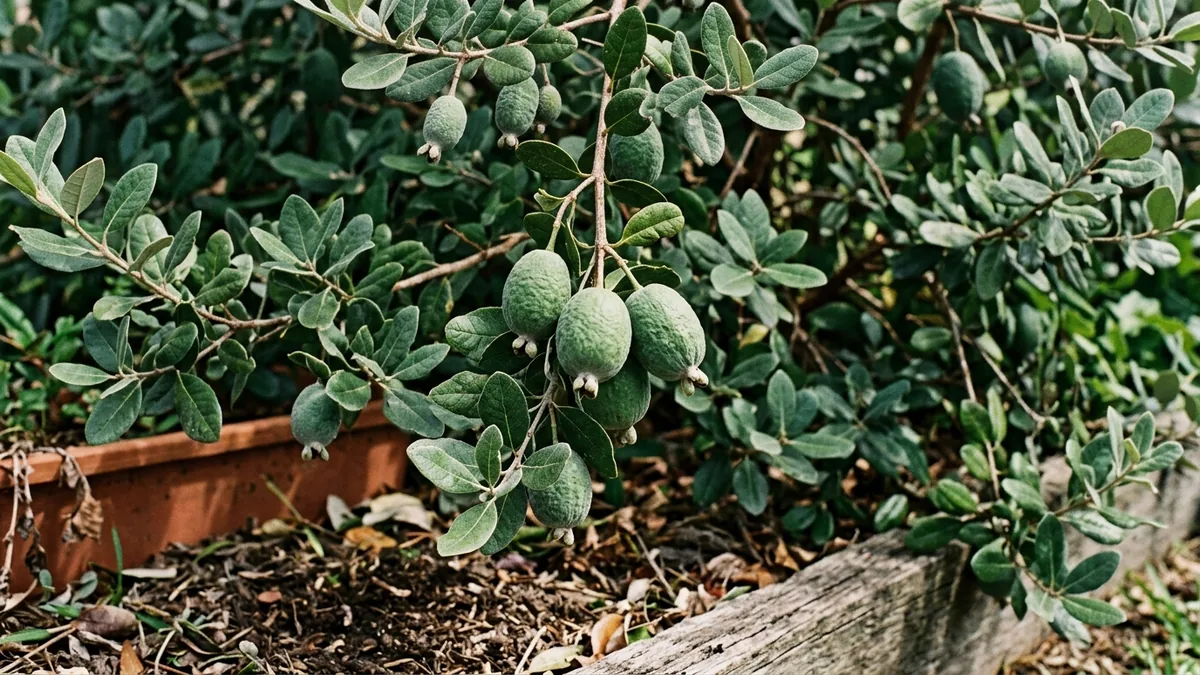
Muffins, loaf, crumble, chutney, jam and freezing, in metric quantities
A feijoa glut is easy to use up once you have a few reliable recipes: muffins, a loaf, a crumble, a pot of chutney and a batch of jam, with the rest frozen as pulp. The quantities below are metric and the oven temperatures are for a standard (non-fan) oven; drop them by 20 degrees if you bake with a fan.
Feijoas are ripe when they drop from the bush, so the glut arrives all at once in autumn and you collect it from the ground most days. The notes on ripeness, storing and freezing come first, then the recipes.
The short answer: bake muffins or a loaf with the soft fruit, make chutney and jam when you have a few kilograms, and scoop the rest into freezer bags. Fresh fruit keeps about a week in the fridge; pulp keeps for months in the freezer.
How to tell a feijoa is ready
Feijoas are ripe when they let go of the bush, which is why most gardeners gather windfalls rather than picking from the branch. Our feijoa growing guide has the harvest timing for each region and the feijoa plant page has the quick facts. Fruit that falls is usually ready to use that day or within a couple of days.
Cut one in half to check. Ripe flesh is translucent and jelly-like around the seeds, and the fruit gives slightly under your thumb. White, opaque flesh means it needs a few more days on the bench. Flesh that has gone brown through the middle is overripe, and it is fine to cook with if it smells sweet and is brown only near the skin, but bin anything fermented, mouldy or sour smelling.
Windfalls that have lain on wet ground for several days bruise and spoil quickly, so gather daily during the peak and keep the fruit out of the sun.
What to do with a feijoa glut
When the bucket fills faster than the family can eat, work through these in order of effort.
- Eat or share fresh. Halve and scoop with a teaspoon. Neighbours, the workplace kitchen and a box at the gate all take feijoas happily.
- Bake. Muffins, a loaf and a crumble use the soft, very ripe fruit that is awkward to eat by hand.
- Freeze the pulp. This is the lowest effort way to save a large amount. Details are below.
- Preserve. Chutney and jam turn a few kilograms into jars that keep for months.
- Dry slices. Thin slices can go in a dehydrator, see our dehydrating guide for temperatures and drying checks.
Storing fresh feijoas
- Ripe fruit keeps in the fridge for about a week, in a container or paper bag lined with a tea towel.
- Unripe fruit sits on the bench at room temperature and ripens over a few days. Move it to the fridge once it gives under your thumb.
- Do not wash fruit before storing it. Rinse just before use.
- Check the container every day or two and remove any fruit that has started to ferment, because one bad fruit spoils the neighbours.
Freezing feijoa pulp
Pulp freezes well and goes straight into baking, smoothies or a pot of chutney later in the year. Our freezing guide covers the general rules.
- Halve the ripe fruit and scoop the flesh into a bowl with a teaspoon.
- Mash roughly with a fork or potato masher. Leave it chunky if you want to use it in muffins.
- Measure it into portions that match your recipes. 300 g and 500 g are handy, because the recipes below use about that much.
- Spoon each portion into a freezer bag, press it flat, squeeze out the air and label it with the date. Flat bags freeze fast and stack neatly.
- Freeze for up to 12 months for the best flavour. Thaw in the fridge overnight, and use it within a day or so once thawed.
Cut flesh browns when it meets air. A teaspoon of lemon juice per 500 g of pulp slows the browning, although frozen pulp that has darkened slightly is still fine for baking and chutney.
Feijoa muffins
These make 12 medium muffins, and they are a good way to use soft fruit and pulp straight from the freezer once thawed.
Ingredients
- 300 g self-raising flour
- 150 g brown sugar
- 1 teaspoon ground cinnamon
- 2 eggs
- 100 g butter, melted and cooled
- 250 ml milk
- 250 g feijoa flesh, roughly chopped or mashed (about 6 to 8 fruit)
Method
- Heat the oven to 190°C and grease or line a 12-hole muffin tin.
- Stir the flour, sugar and cinnamon together in a large bowl.
- Whisk the eggs, melted butter and milk in a jug, then pour into the dry ingredients with the feijoa.
- Fold together with a few strokes only. A lumpy batter gives light muffins.
- Divide between the holes and bake for 20 to 25 minutes, until golden and a skewer comes out clean.
- Rest in the tin for 5 minutes, then move to a rack.
Muffins keep in an airtight container for two days, or freeze them for up to three months.
Feijoa loaf or cake
This is a moist, plain loaf that slices well and works as a cake if you bake it in a round tin.
Ingredients
- 250 g self-raising flour
- 150 g caster sugar
- 100 g butter, melted
- 2 eggs
- 125 ml milk
- 300 g feijoa pulp, mashed
- 1 teaspoon vanilla extract
- 1 teaspoon mixed spice (optional)
Method
- Heat the oven to 180°C. Grease and line a 23 cm by 13 cm loaf tin, or a 20 cm round cake tin.
- Combine the flour, sugar and mixed spice in a bowl.
- Beat the eggs with the melted butter, milk and vanilla, then stir in the feijoa pulp.
- Pour the wet mixture into the dry and stir until just combined.
- Bake the loaf for 50 to 55 minutes, or the round cake for 35 to 40 minutes, until a skewer comes out clean.
- Cool in the tin for 10 minutes before turning out.
For a cake, ice it with cream cheese icing or dust with icing sugar. A loaf is nice sliced and buttered.
Feijoa crumble
A crumble uses firm or just ripe fruit that is too sharp to eat fresh. It serves six.
Ingredients
- 700 g feijoa flesh, sliced (about 20 fruit)
- 60 g sugar
- 1 tablespoon lemon juice
- 150 g plain flour
- 100 g rolled oats
- 100 g brown sugar
- 120 g cold butter, cubed
Method
- Heat the oven to 180°C.
- Toss the feijoa with the sugar and lemon juice and tip into a 22 cm baking dish.
- Rub the butter into the flour, oats and brown sugar with your fingertips until the mixture looks like coarse crumbs.
- Scatter over the fruit and bake for 35 to 40 minutes, until the top is golden and the fruit bubbles at the edges.
Serve warm with custard, cream or ice cream.
Feijoa chutney
Chutney is the best use for a big batch of feijoas, because the vinegar and long cooking give it a long shelf life. This recipe makes five or six 250 ml jars. It is our own recipe built on the vinegar to fruit ratio of the tested tomato-apple chutney published by the US National Center for Home Food Preservation, with more vinegar per kilogram of fruit than that recipe. It has not been lab tested itself, so keep the jars in the fridge and use them within three months.
Ingredients
- 1 kg feijoa flesh, chopped (about 25 fruit)
- 300 g onions, finely chopped
- 300 g sultanas
- 400 g brown sugar
- 500 ml white vinegar with 5 percent acetic acid (check the label)
- 2 teaspoons ground ginger
- 1 teaspoon mixed spice
- 1 teaspoon salt
- 1 teaspoon chilli flakes (optional)
Method
- Put everything in a large, wide, non-reactive pot (stainless steel or enamel).
- Bring to the boil, then simmer gently for 45 to 60 minutes, stirring often, until thick and a spoon drawn across the base leaves a clear trail.
- Wash six 250 ml jars and lids in hot soapy water, rinse, and sterilise as in the jam instructions below.
- Ladle the boiling hot chutney into the hot jars, leaving 1 cm of headspace. Wipe the rims and seal.
- Let the jars cool on the bench, then move them to the fridge. Do not reduce the vinegar or increase the onion and fruit.
Leave chutney in the fridge for two to three weeks before opening, so the flavour mellows, and use it within three months of making it. For a chutney that keeps in the pantry, use a lab tested recipe such as the ones in our tomato relish and chutney guide. Our bottling and jam guide has the full water bath method and altitude adjustments.
Feijoa jam
Feijoas are moderate in natural pectin, so this jam relies on lemon juice for acid and a full amount of sugar for set and keeping quality. It makes four or five 250 ml jars.
Ingredients
- 1 kg feijoa flesh, finely chopped or roughly mashed
- 800 g white sugar
- 60 ml lemon juice (about 2 lemons)
- 125 ml water
Method
- Put the feijoa, water and lemon juice in a wide pot and simmer for 10 minutes, until the fruit is soft.
- Add the sugar and stir over low heat until it dissolves completely.
- Raise the heat and boil hard, stirring often, until the jam reaches 104.5°C on a jam thermometer. Without a thermometer, put a teaspoon on a cold saucer from the freezer: after a minute it should wrinkle when you push it with a finger. This takes 15 to 25 minutes.
- Skim off any foam.
- Pour into clean, hot jars, leaving 6 mm of headspace, and seal with new or clean lids.
- Process the filled jars in a boiling water bath for 5 minutes. If the jars were only washed rather than sterilised, process for 10 minutes.
To sterilise jars, wash them and boil them in a covered pot for 10 minutes, lifting them out just before filling. The jam keeps in a cool, dark place for up to a year. Once open, keep it in the fridge. Our jam and jelly guide covers setting points and troubleshooting.
Safe preserving rules for chutney and jam
- Use the full amount of sugar in the jam and the full amount of vinegar in the chutney. Both are what keep the jars safe.
- Use vinegar that states 5 percent acetic acid on the label. Some vinegars sold in supermarkets are weaker.
- Do not add low-acid vegetables such as pumpkin, courgette or capsicum to the chutney above the amounts given.
- Throw away any jar with a bulging lid, a lid that flexes, mould, fizzing or an off smell. Do not taste it first.
- Refrigerate after opening.
New Zealand Food Safety (part of MPI) notes that the main botulism risk in home preserving comes from low-acid foods. Feijoa is a high-acid fruit, and the added vinegar and sugar keep these recipes in safe territory when the quantities are followed. See the what to preserve guide for the full list of foods and methods, and the pickling guide for vinegar pickles.
Quick reference
| Recipe | Feijoa flesh | Oven or cook | Time | Keeps |
|---|---|---|---|---|
| Muffins (12) | 250 g | 190°C | 20 to 25 minutes | 2 days, or 3 months frozen |
| Loaf or cake | 300 g | 180°C | 50 to 55 minutes (loaf), 35 to 40 (cake) | 3 days |
| Crumble (6) | 700 g | 180°C | 35 to 40 minutes | 2 days in the fridge |
| Chutney (5 to 6 jars) | 1 kg | Simmer | 45 to 60 minutes | 3 months in the fridge |
| Jam (4 to 5 jars) | 1 kg | Boil to 104.5°C | 15 to 25 minutes | Up to 1 year processed |
| Frozen pulp | Any amount | Freezer | Freeze flat | Up to 12 months |
Growing more feijoas
If the recipes have made you wish for a bigger crop, feijoa bushes are hardy and long lived. Frost-prone regions such as Central Otago and Canterbury suit the early-ripening varieties best, and the frost dates page shows when your first frost is likely. The feijoa growing guide covers planting, pollination partners and pruning.
Questions
How do you know when a feijoa is ripe?
Ripe feijoas drop from the bush. Cut one open: translucent, jelly-like flesh means ripe, and white opaque flesh needs a few more days on the bench.
How long do fresh feijoas keep?
Ripe fruit keeps about a week in the fridge. Unripe fruit ripens on the bench over a few days.
Can you freeze feijoas?
Yes. Scoop out the flesh, mash it, freeze it flat in labelled bags and use it within 12 months for the best flavour. Thaw it in the fridge before baking.
How much sugar does feijoa jam need?
This recipe uses 800 g of sugar per 1 kg of feijoa flesh with 60 ml of lemon juice. Do not cut the sugar, because it gives the set and keeps the jam safe.
How long does feijoa chutney keep?
This recipe has not been lab tested, so keep the jars in the fridge and use them within three months. For a pantry chutney, use a lab tested recipe such as the ones in our tomato relish and chutney guide.
What can I do with very ripe feijoas?
Soft, very ripe fruit is best in muffins, the loaf or smoothies, or mashed and frozen as pulp for later.
Sources
- National Center for Home Food Preservation: Tomato-Apple Chutney (tested vinegar ratio)
- National Center for Home Food Preservation: Jams and Jellies
- New Zealand Food Safety (MPI): home preserving and botulism
Plant profile
The feijoa profile has sowing times for your region, companion plants and common pests.