
How to Save Seeds From Your Garden in New Zealand
Updated June 2026
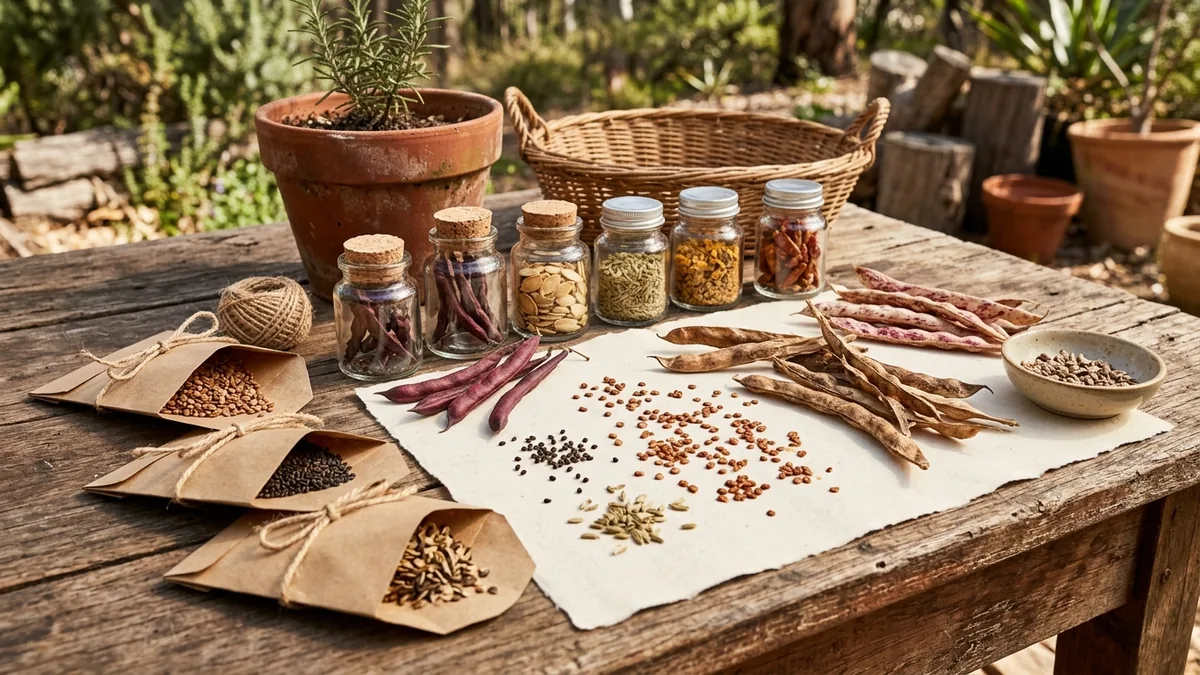
Grow free seed, adapt your plants to your patch, and build a garden that feeds itself, with a picker that tells you if you can save from any crop
Saving your own seed is one of the oldest gardening habits there is, and one of the most rewarding. It saves you money, since a single lettuce left to flower can give you hundreds of seeds for free. It lets you adapt your plants to your own garden over the years, because the seed you keep comes from the plants that did best in your soil and climate. It builds real food resilience, so you are never stuck waiting on a seed order. And it gives you something to share, because gardeners who save seed end up with plenty to swap.
The one thing to get right first
Open-pollinated and heirloom seeds come true to type. F1 hybrid seeds do not.
An open-pollinated or heirloom variety, grown from its own seed, gives you the same plant again next year. An F1 hybrid is a cross between two parent lines, and the seed you save from it will not come true. The next generation is an unpredictable mix of the grandparent traits, often weaker or quite different. So save seed from open-pollinated plants, and check your seed packet, which will say F1 or hybrid if it is one.
Can I Save Seed From This?
Pick a crop and this tool tells you how easy it is for a beginner, whether it self-pollinates or cross-pollinates, whether it is commonly sold as an F1 hybrid (so you should check your packet), and a one-line how-to for saving the seed. Crops marked biennial only flower and set seed in their second year.
Saving Seed Well, the Basics
Good seed comes from a few simple habits. Get these right and your saved seed will store for years and come up strong.
Harvest at full maturity
Seed must finish ripening on the plant, well past the eating stage. Let beans and peas dry in the pod, let lettuce and rocket bolt and form fluffy seed heads, and let tomatoes and cucumbers go fully ripe or even a little soft.
Dry-seeded vs wet-seeded
Dry-seeded crops (beans, peas, lettuce, coriander, brassicas) dry in pods or heads on the plant, so you just collect and clean them. Wet-seeded crops (tomato, cucumber, pumpkin) have seed in wet flesh that needs scooping, cleaning and in the case of tomatoes a short ferment.
Dry thoroughly, then label
Spread seed on paper or a plate out of direct sun until it is bone dry, a week or two for most crops. Then label every batch with the variety and the year. Unlabelled seed becomes a mystery within months.
Store cool, dark, dry, airtight
Paper envelopes inside an airtight jar, kept in a cool dark cupboard or the fridge, is the gold standard. Heat and moisture are what kill stored seed, so keep both out.
The tomato ferment, the one wet-seed job worth learning
Tomato seed is coated in a gel that stops it sprouting inside the fruit. To remove it, scoop the seed and pulp into a jar, add a splash of water, and leave it on the bench for about three days until a layer of mould forms on top and the good seed sinks. Pour off the mould, pulp and any floating seed, rinse the sinkers in a sieve until clean, then spread to dry. The ferment also kills off some seed-borne diseases. Cucumber seed is cleaned the same way but does not strictly need the ferment.
How long saved seed lasts
Stored well, viability varies a lot by crop. Beans, peas, tomato and brassicas keep about 4 to 5 years. Lettuce, capsicum, cucumber and pumpkin keep about 3 to 4 years. Onion, leek, parsnip, corn and silverbeet are short-lived, often only 1 to 2 years, so save these fresh each time you can.
A quick germination test
Before you sow older seed, test it. Fold ten seeds into a damp paper towel, slip it in a plastic bag somewhere warm, and check after a week or so. If seven sprout, you have roughly 70 percent germination and can sow a little thicker to compensate. If only one or two come up, it is time for fresh seed.
Avoiding Crosses, Honestly
This is the part that trips up new seed savers. Self-pollinating crops like tomato, bean, pea, lettuce and capsicum pollinate themselves before the flower even opens, so they come true with no effort, even if other varieties grow nearby. Cross-pollinating crops are the opposite, and need a bit of care.
- Grow one variety at a time. The simplest answer for cross-pollinators like pumpkin, courgette, cucumber, corn and brassicas is to grow a single variety of each species in a season. No other variety nearby means nothing to cross with.
- Isolation distance. If you grow more than one variety, separate them. Insect-pollinated crops like cucurbits and brassicas ideally want a few hundred metres between varieties, which is rarely possible in a backyard. Wind-pollinated corn wants several hundred metres too, or staggered sowing so they flower at different times.
- Bagging and hand-pollination. For precious cucurbit seed, tape female and male flowers shut the evening before they open, hand-pollinate by hand the next morning, then re-tape and tag the fruit. It is fiddly but gives you true seed in a small garden.
- Remember the neighbours. Bees travel, so a neighbour's pumpkin or a flowering brassica gone to seed down the street can cross with yours. This is why saved cucurbit seed sometimes grows strange fruit.
Your garden, saving its own seed, tracked in one place
The Planting Season app keeps a seed inventory of what you have and what to buy, links it to your beds and your logged harvests, and connects the dots between what you grow, save and sow next season. Seed saving is the loop that closes the whole self-sufficient garden.
Open the App →Frequently Asked Questions
Can I save seed from supermarket vegetables?
Sometimes, but it is a gamble. Most supermarket produce is grown from F1 hybrid seed, so any seed you save will not grow true to type. Supermarket fruit is also often picked unripe or treated, which can leave the seed immature or unviable. You can experiment with mature, fully ripe items like dried beans, a ripe heirloom tomato or a pumpkin, but for reliable results start with open-pollinated or heirloom seed from a packet or a known plant.
What is an F1 hybrid seed?
An F1 hybrid is the first-generation cross between two different parent lines, bred for traits like vigour or uniformity. F1 plants perform well, but seed saved from them does not come true. The next generation is a mix of the grandparent traits and is unpredictable, so F1 is not worth saving for seed. Check your seed packet: it will say F1 or hybrid if it is one. Open-pollinated and heirloom varieties are the ones to save.
What are the easiest seeds to save?
Tomatoes, beans, peas, lettuce and capsicum are the easiest. They are self-pollinating, so they come true to type without any isolation, and the seed is easy to collect. Beans and peas just dry on the plant in their pods. Lettuce is left to bolt and the fluffy seed is collected. Tomatoes need a quick few-day ferment to clean the seed. Start with these before tackling cross-pollinating or biennial crops.
How long do saved seeds last?
It depends on the crop and how well they are stored. Kept cool, dark, dry and airtight, beans, peas, tomatoes and brassicas last about 4 to 5 years, lettuce and cucumber about 3 to 4 years, while onion, leek, parsnip and corn last only 1 to 2 years. A quick germination test on a damp paper towel tells you if older seed is still worth sowing.
Why did my saved pumpkin seed grow weird fruit?
Pumpkins, courgettes and other cucurbits cross-pollinate readily. If you grew more than one variety within range, or your neighbour did, bees move pollen between them and the seed carries a mix of both. The fruit you ate looks normal because that is the mother plant, but the seed inside is crossed, so the next generation can be strange in shape, colour or flavour. To save true pumpkin seed, grow only one variety of each species, or hand-pollinate and bag the flowers.
Can I save seed from a hybrid plant?
You can collect the seed, but it will not grow true to type. F1 hybrid offspring are a mix of the parent traits and are unpredictable, often weaker or quite different from the plant you saved from. If you want reliable, repeatable results, only save seed from open-pollinated or heirloom varieties. Saving from a hybrid can be a fun experiment, just do not rely on it.
Is it legal to save seed in New Zealand?
Yes. Home gardeners can legally save seed from open-pollinated and heirloom varieties for their own use and to share. The main exception is varieties protected by Plant Variety Rights, which cannot be propagated for commercial sale without a licence. Saving for your own garden is not affected by those rules.
See also: Raising Plants from Seed and How to Grow Tomatoes