
Rhubarb Recipes: Stewed Rhubarb, Crumble, Cake and Small-Batch Jam
Updated November 2026
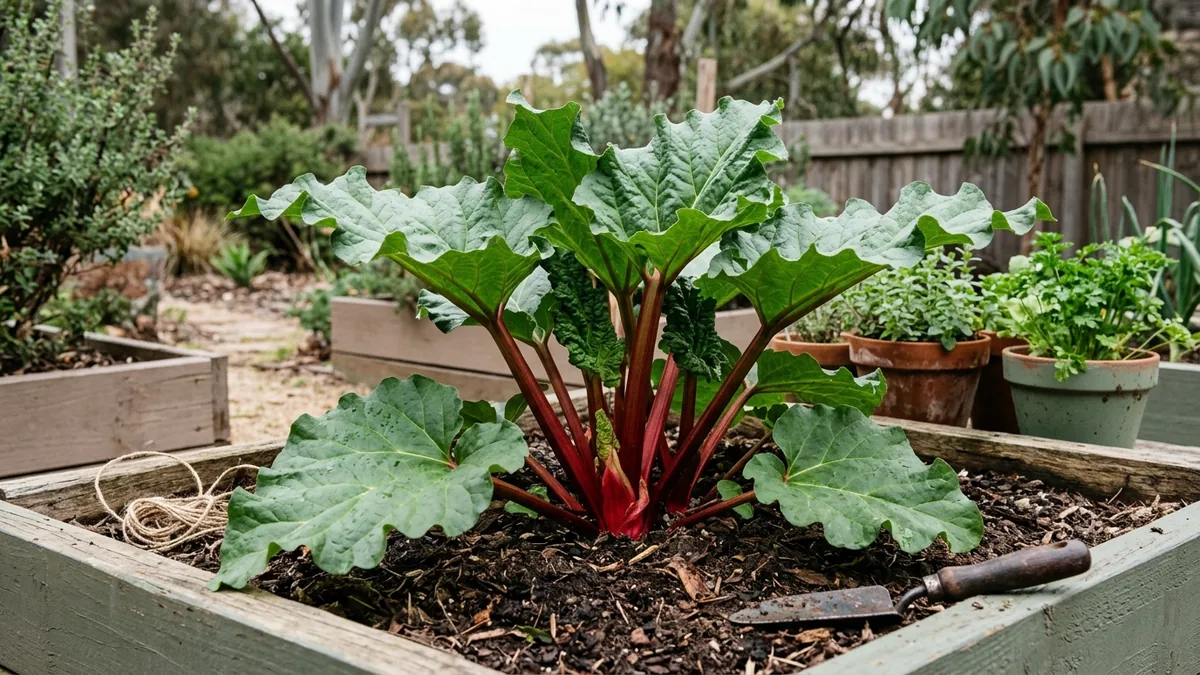
Four reliable recipes for a productive rhubarb clump, with when to pull and how to freeze the rest
Rhubarb is one of the easiest perennials to keep going and one of the few that crops for most of the year, so a single established clump can feed a family through stewed rhubarb on porridge, a crumble on Sunday and a cake for the tin. This page has four recipes in metric quantities, and the notes on pulling, trimming and freezing that make them work.
Oven temperatures on this page are for a standard (non-fan) oven. If you bake with a fan, lower each temperature by 20 degrees and check the food a few minutes early.
The short answer: chop 500 g of trimmed rhubarb, add 80 g of sugar and 2 tablespoons of water, and simmer gently for 8 to 10 minutes until the stalks just collapse. Never eat the leaves.
Never eat rhubarb leaves
Only the stalks are eaten. The leaf blades contain high levels of oxalic acid and related compounds and are toxic, so cut them off at the top of the stalk and put them on the compost heap. Our rhubarb growing guide repeats this because it is the one rule that matters. Do not use leaves as a garnish or in any recipe.
When rhubarb is ready in New Zealand
Rhubarb is a hardy perennial. Our harvest data lists stalks as available in every month of the year, and in practice the tenderest, reddest stalks come in spring and early summer, while stalks pulled in the heat of summer are thinner and greener. Crowns are planted rather than sown, and our data gives these planting months for each region.
| Region | Planting months |
|---|---|
| Northland | Jan to Apr and Aug to Oct |
| Auckland | Jan to Apr and Aug to Oct |
| Waikato & Bay of Plenty | Jan to Apr and Aug to Oct |
| Central North Island | Jan to Apr and Aug to Oct |
| Wellington & Lower North Island | Jan to Apr and Aug to Oct |
| Nelson & Marlborough | Jan to Apr and Aug to Oct |
| Canterbury | Mar to Apr and Sep to Nov |
| Otago & Southland | Sep to Nov |
| Central Otago | Sep to Nov |
Leave a newly planted crown alone in its first year, take only a light pick in year two and harvest freely from year three. Pull stalks with a twist rather than cutting them, and never strip more than about a third of the plant at once. The rhubarb plant page has the quick facts and the best companion plants.
Preparing rhubarb
Pull the stalks, cut off the leaves and the pale base, and rinse them. Thin stalks need no peeling. Thick, older stalks can have stringy outer fibres, which you can peel off with a vegetable peeler from the cut end, the way you would string celery. Cut the stalks into 2 to 3 cm pieces for stewing and baking.
Red stalks give a pink dish, and green stalks taste the same but stew to a duller colour. A handful of strawberries or raspberries in the pot brings the colour back. Rhubarb is sharp, and the sugar in these recipes is balanced for tart stalks. Taste after stewing and add more sugar a tablespoon at a time if yours is sour.
Stewed rhubarb
Stewed rhubarb is the base for everything else and takes ten minutes. This makes about 2 cups, enough for four servings with yoghurt or porridge.
Ingredients
- 500 g trimmed rhubarb, cut in 2 to 3 cm pieces
- 80 g sugar (about 1/3 cup)
- 2 tablespoons water
- 1 strip of orange peel or 1 teaspoon grated fresh ginger (optional)
Method
- Put the rhubarb, sugar, water and orange peel in a saucepan over low to medium heat.
- Cover and cook gently for 5 minutes, stirring once, until the juice runs.
- Uncover and simmer for another 3 to 5 minutes until the pieces are tender but still holding their shape. Overcooked rhubarb turns to mush.
- Taste, add more sugar if needed, and remove the orange peel. Serve warm or cold.
It keeps in the fridge for five days and freezes for up to 12 months in labelled containers.
Rhubarb crumble
A crumble is the classic way to use a heap of rhubarb. This serves six.
Ingredients
- 700 g trimmed rhubarb, cut in 3 cm pieces
- 100 g sugar
- 2 tablespoons plain flour
- 1 teaspoon grated orange zest
- Topping: 150 g plain flour, 100 g rolled oats, 100 g brown sugar, 125 g cold butter cut small, 1/4 teaspoon salt
Method
- Heat the oven to 180°C and grease a 1.5 litre baking dish.
- Toss the rhubarb with the sugar, flour and zest and tip it into the dish.
- For the topping, rub the butter into the flour, oats, brown sugar and salt until it looks like rough breadcrumbs with a few larger lumps.
- Scatter the topping evenly over the rhubarb without pressing it down.
- Bake for 40 to 45 minutes until the topping is golden and the juice bubbles at the edges. Rest for 10 minutes before serving.
Leftovers keep in the fridge for three days and reheat well in a 160°C oven.
Rhubarb cake
This is a simple tea cake with rhubarb baked into the top. It makes one 22 cm round cake, enough for ten slices.
Ingredients
- 250 g plain flour
- 2 teaspoons baking powder
- 1/4 teaspoon salt
- 125 g softened butter
- 150 g sugar, plus 2 tablespoons for the top
- 2 eggs
- 1 teaspoon vanilla
- 125 ml milk
- 300 g trimmed rhubarb, cut in 1.5 cm pieces
Method
- Heat the oven to 180°C and line the base of a 22 cm springform tin with baking paper.
- Sift the flour, baking powder and salt together.
- Beat the butter and 150 g of sugar for 3 to 4 minutes until pale. Beat in the eggs one at a time, then the vanilla.
- Fold in the flour mix in two lots, alternating with the milk, until just combined.
- Spread the batter in the tin, scatter the rhubarb over the top and sprinkle with the remaining sugar.
- Bake for 45 to 55 minutes until a skewer in the cake part comes out clean. Cool in the tin for 15 minutes.
The cake keeps for two days at room temperature in a sealed tin, or four days in the fridge because of the fruit.
Small-batch rhubarb and ginger jam
This jam has not been lab tested for shelf storage, so it is made as a small batch for the fridge and freezer only. It makes about 3 jars of 250 ml.
Ingredients
- 600 g trimmed rhubarb, cut in 1.5 cm pieces
- 450 g sugar
- Juice of 1 lemon (about 50 ml)
- 2 teaspoons grated fresh ginger
Method
- Layer the rhubarb and sugar in a bowl, add the lemon juice and ginger, cover and leave for 2 to 3 hours or overnight until the sugar dissolves into a syrup.
- Tip everything into a wide pot and bring to the boil over medium heat, stirring.
- Boil for 15 to 25 minutes, skimming any foam, until the jam reaches 104°C on a jam thermometer or a spoonful wrinkles when pushed on a chilled saucer.
- Ladle into clean, hot jars, seal and cool. Label with the date.
Keep the jam in the fridge and use it within four weeks, or freeze it in the jars with 2 cm of headspace for up to 12 months. For a shelf-stable jam, follow a tested method such as the ones in our bottling and jam guide, which follows the National Center for Home Food Preservation.
Freezing a rhubarb glut
Raw rhubarb freezes very well and needs no blanching. Wash and dry the stalks, cut them into 2 to 3 cm pieces, spread them on a tray and freeze for two hours, then bag the pieces. They stay separate and can be scooped out by the cup for crumbles and stewing, straight from frozen. Use within 12 months. Our freezing the harvest guide covers the general rules. Stewed rhubarb also freezes well and is useful for pies and for folding into yoghurt.
Quick reference
| Recipe | Rhubarb | Oven or cook | Time | Keeps |
|---|---|---|---|---|
| Stewed rhubarb (4 serves) | 500 g | Simmer | 8 to 10 minutes | 5 days in the fridge, 12 months frozen |
| Crumble (6) | 700 g | 180°C | 40 to 45 minutes | 3 days in the fridge |
| Cake (10 slices) | 300 g | 180°C | 45 to 55 minutes | 2 days, or 4 in the fridge |
| Small-batch jam (3 jars) | 600 g | Boil to 104°C | 15 to 25 minutes | 4 weeks in the fridge, 12 months frozen |
Questions
Are rhubarb leaves poisonous?
Yes. The leaf blades are toxic and must never be eaten. Cut them off and compost them, and eat only the stalks.
Do I need to peel rhubarb?
Young, thin stalks need no peeling. Thick stalks can have stringy outer fibres, which you can peel off from the cut end.
Can I freeze raw rhubarb?
Yes. Cut it into 2 to 3 cm pieces, freeze on a tray, then bag it. It keeps for up to 12 months and goes straight into crumbles from frozen.
Why is my stewed rhubarb mushy?
It has been cooked too long or too hard. Stew it gently for 8 to 10 minutes and stop as soon as the pieces start to collapse, because they keep softening in the hot juice.
How much sugar does rhubarb need?
These recipes use about 80 g of sugar per 500 g of rhubarb for stewing, and more for jam. Taste and add sugar a spoonful at a time, because stalk sourness varies.
Sources
- New Zealand Food Safety (MPI): food safety in the home
- National Center for Home Food Preservation: tested home preserving methods
Plant profile
The rhubarb profile has sowing times for your region, companion plants and common pests.