
When to Plant Garlic in New Zealand: How to Grow, Harvest and Store
Updated October 2026
Garlic is one of the most satisfying crops in the New Zealand garden. You plant a single clove and it returns a whole bulb. The classic Kiwi rule of thumb is to plant on the shortest day and harvest on the longest, which lines garlic up beautifully with our winter-to-summer growing season. Get the timing and the cloves right, and the rest is mostly patience.
Garlic needs two things from the season to bulb up properly: a spell of cold over winter, and lengthening days through spring. That is exactly what our shortest-day-to-longest-day tradition delivers. This guide covers the timing for your region, how much seed garlic to buy, which New Zealand varieties suit where you live, and how to grow fat, well-keeping bulbs.
🌱 Plant profile: Garlic, with sowing times for your region, companion plants and common pests.
When to Plant Garlic in Your Region
Garlic is planted as cloves from autumn into winter. These are the planting months for each of our nine New Zealand regions, straight from our planting data. The shortest day, around 21 June, falls inside every region's window. Each region links to its vegetable planting calendar, and the Garlic plant page has spacing, companions and care notes for your region.
| Region | Plant cloves | Local note |
|---|---|---|
| Northland | April to July | Softneck types such as Printanor or Takahue suit the warm north. |
| Auckland | April to July | Softneck and intermediate types like Printanor do well here. |
| Waikato & Bay of Plenty | April to July | Printanor is reliable across these warm districts. Keep the bed free draining over winter. |
| Central North Island | April to July | Cold winters suit hardneck and turban types as well as Printanor. |
| Wellington & Lower North Island | April to July | Printanor is a safe choice, and cooler winters let you try hardneck types for their scapes. |
| Nelson & Marlborough | April to July | A good cold winter suits Printanor, hardneck types and Rakaia. |
| Canterbury | April to July | Cold winters suit hardneck and turban types, Printanor and Rakaia. Plant in free-draining, raised soil. |
| Otago & Southland | April to July | Ideal for hardneck types and good keepers like Rakaia. Expect a slightly later harvest. |
| Central Otago | April to June | Plant Apr to Jun before the ground freezes hard. Garlic needs the winter chill and is fully hardy. |
Garlic planting calculator and timing
1. How many cloves do I need? Cloves are planted 15 centimetres apart.
2. When do I plant, and which type?
What it looks like as it grows


Position and soil
Garlic wants a sunny, open spot with at least six hours of sun a day. The single most important thing is drainage, because garlic sitting in cold wet soil over winter is prone to rot. If your soil is heavy, grow it in raised beds or mound the rows up.
Work in plenty of compost or well-rotted manure before planting. Garlic is a hungry crop over its long season and rewards rich, free-draining soil. Aim for a pH around 6.0 to 7.0. Rotate garlic away from where you grew onions, leeks or garlic last year to keep soil-borne problems down.
How to Plant Garlic Cloves
Just before planting, gently break the bulb into individual cloves, keeping the papery skin on each one. Plant the largest, healthiest cloves and save the small inner ones for the kitchen, as bigger cloves grow bigger bulbs. Push each clove in pointy end up, about 3 to 5 centimetres deep, so the tip sits just below the surface.
Space cloves 15 centimetres apart in rows about 25 to 30 centimetres apart. Water in well, then mulch lightly to suppress weeds and hold moisture. Use the planting calculator above to work out exactly how many cloves and bulbs you need for your bed.
When in the window to plant
Our data gives every region from Northland to Otago and Southland an April to July planting window, and Central Otago April to June, so the cloves go in before the ground freezes hard. The shortest day sits inside all of these windows, so the tradition still works wherever you garden. Planting too late is one of the usual causes of small bulbs, so aim to have your cloves in the ground before your window closes. In the warm north, do not plant too early either, because garlic still needs a cool spell to bulb.
Spacing
Stick to 15 centimetres between cloves. Crowd them and you get small bulbs, because each plant needs room and light to size up. The rows themselves can be 25 to 30 centimetres apart, which gives you easy access for weeding through the season.
Watering and feeding
Keep the bed weed free, as garlic competes poorly with weeds. Water steadily through spring when the bulbs are sizing up, then ease right off as harvest approaches so the bulbs can firm and the skins cure. Feed with a nitrogen-rich liquid feed in early spring to push leaf growth, since each leaf becomes a wrapper layer on the bulb, but stop feeding nitrogen once the bulbs start to swell.
If your garlic sends up a flower stalk, or scape, on hardneck types, snap it off. This sends the plant's energy back into the bulb, and the scapes themselves are delicious stir-fried.
Growing Garlic in Pots
Garlic grows well in containers, which suits balconies, courtyards and gardens with heavy, wet soil. Our plant data calls for a pot at least 20 cm deep, and a wider pot or trough lets you plant more cloves at the same 15 centimetre spacing you would use in the ground. Use a free-draining potting mix with some compost through it, because waterlogged mix rots cloves just as quickly as wet garden soil.
Plant at the same time as you would in the garden, pointy end up and 3 to 5 centimetres deep. Pots dry out faster than beds, so check them through dry spells in winter and spring. Give a nitrogen-rich liquid feed every few weeks while the leaves are growing, then ease off once the bulbs start to swell, and stop watering as the tops yellow. Our garlic in containers guide covers pots, mixes and watering in more detail.
Problems and pests
The main disease to watch for is rust, which shows as orange spots on the leaves in warm, humid conditions. Good spacing, airflow and crop rotation all help. Avoid overhead watering late in the day. Rot in the bulb usually comes back to poor drainage, so raised beds and free-draining soil are your best defence. See our New Zealand pest and disease guide for organic options.
How Long Does Garlic Take to Grow?
Garlic is a slow crop. Our plant data allows about 210 days, roughly seven months, from planting a clove to lifting a bulb. Cloves planted in May or June reach that point in December or January, which is why the shortest day to longest day tradition works so well. An April planting in the warm north can be ready to check a little earlier, and the colder south tends to lift a little later.
The leaves grow first, and each leaf becomes a wrapper around the bulb, so the leafy growth through winter and early spring sets up the size of the bulb. The bulbs then size up through spring as the days lengthen, which is when steady watering matters most.
When to Harvest Garlic and How to Store It
Lift garlic when the lower leaves have yellowed and died back but several green leaves remain up top, usually around late December into January. Each green leaf is a wrapper around the bulb, so harvesting while a few are still green gives you bulbs that store well. Loosen with a fork rather than pulling, to avoid bruising.
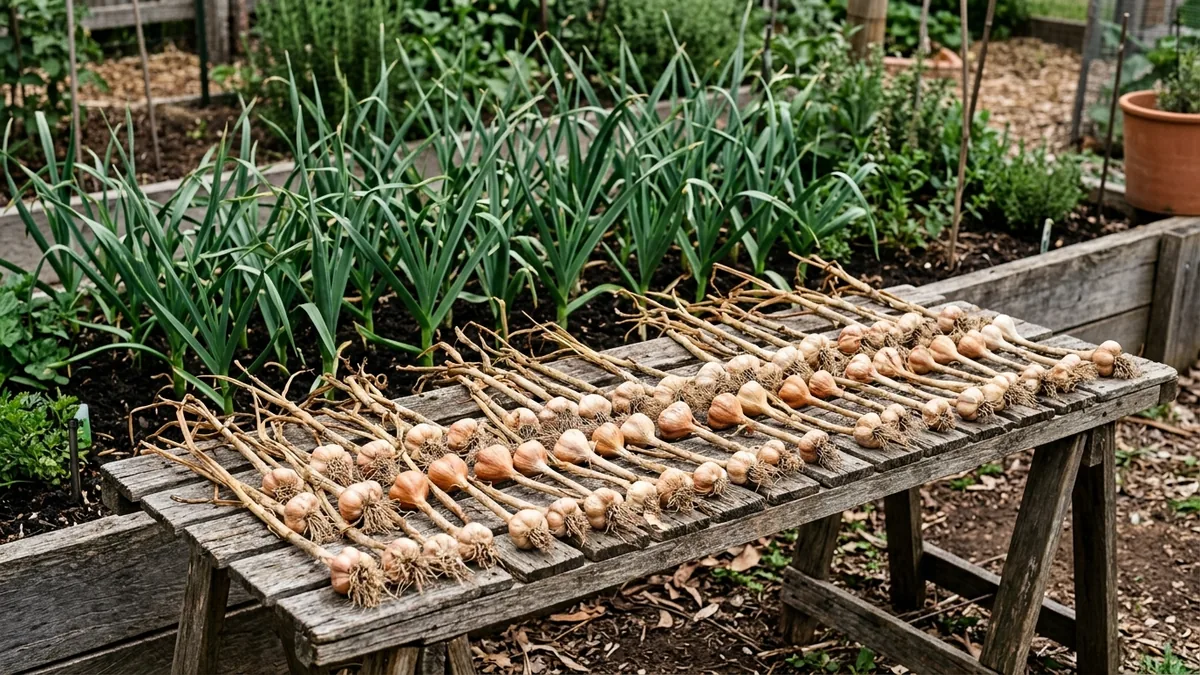
Cure the bulbs by hanging or laying them out in a dry, airy, shaded spot for two to three weeks until the skins are papery and the necks dry. Once cured, trim the roots and tops, or plait softneck types, and store in a cool, dry, airy place. Well-cured softneck garlic keeps for many months. Set your best bulbs aside as next year's seed.
How to check and lift garlic
Before you lift the whole bed, scrape the soil away from one or two bulbs and look at them. A ready bulb is plump, with cloves that have filled out under the skin. If it is still small, leave the rest to grow on and check again later. Our growing notes put the moment to lift at the point where the lower leaves have browned but the top five or six are still green. If you wait until every leaf is brown, the wrappers break down and the bulbs do not keep as well. Loosen the soil with a fork a little way out from the row and ease the bulbs out rather than pulling them by the stem.
If you have more garlic than you can store, peeled cloves can be frozen.
What to Plant With Garlic
Our companion planting data pairs garlic with beetroot, lettuce, strawberries and tomatoes, and lists fruit trees as good companions too. Keep it away from beans and peas. Whatever you plant nearby, do not let it crowd or shade the row, because garlic competes poorly and each plant needs room and light to size up. Our companion planting guide has more pairings.
Hardneck vs softneck garlic
Most garlic falls into two camps. Softneck types suit the warmer parts of New Zealand, store for a long time and do not send up a flower stalk, so you can plait them. Hardneck and turban types send up an edible scape and tend to do better with a proper cold winter, which makes them a strong choice for the South Island and inland districts. Printanor, the New Zealand standard, is an intermediate type that performs well across most of the country.
Best garlic varieties for New Zealand
Printanor
The standard New Zealand commercial variety and the home-garden benchmark. Reliable nationwide, with good-sized bulbs of around 8 to 12 cloves and dependable keeping. If you only grow one, grow this.
Takahue
A New Zealand heirloom from the Far North with strong, full flavour. Suits warmer areas and rewards growers who like a richer-tasting garlic.
Rakaia
A good keeper with solid bulbs, well suited to cooler South Island conditions. A reliable storing variety for the pantry.
Elephant Garlic
Very large, mild bulbs that are technically a leek relative rather than true garlic. The cloves are big and few, the flavour gentle, and it is fun to grow for its sheer size.
| Variety | Type | Best for | Notes |
|---|---|---|---|
| Printanor | Intermediate | Nationwide, the standard | 8 to 12 cloves, good keeper |
| Takahue | Softneck-leaning | Warmer areas | Strong heirloom flavour |
| Rakaia | Suits cooler areas | South Island | Excellent storing variety |
| Elephant Garlic | Leek relative | Large, mild bulbs | Few big cloves, gentle flavour |
New Zealand season note
The shortest-day-to-longest-day tradition is a great anchor, and our planting data gives a wider window around it. Every region from Northland to Otago and Southland can plant from April to July, and Central Otago from April to June, before the ground freezes hard. The plant needs a cold spell and lengthening days to bulb, so use the timing tool above and the New Zealand planting calendars or the garlic plant page for timing tuned to your district.
Frequently asked questions
When should I plant garlic in New Zealand?
The New Zealand tradition is to plant garlic on the shortest day, around 21 June, and harvest on the longest day, around 21 December. Our planting data gives a wider window around that: April to July in every region from Northland to Otago and Southland, and April to June in Central Otago, where the cloves should go in before the ground freezes hard. The cloves need a cold period and lengthening days to form good bulbs.
Should I use supermarket garlic to plant?
It is far better to use certified New Zealand seed garlic such as Printanor, Takahue or Rakaia. Supermarket bulbs are often imported and may be treated to stop sprouting, and they can carry diseases that build up in your soil. Seed garlic is grown for planting and gives you healthier, more reliable bulbs.
What is the difference between hardneck and softneck garlic?
Softneck garlic suits warmer parts of New Zealand, stores for a long time and does not send up a flower stalk, so you can plait it. Hardneck and turban types send up a scape you can eat, and they do better with a cold winter, which makes them a good choice for the South Island and inland districts. Printanor is an intermediate type that performs across most of the country.
How many cloves do I get from one bulb of garlic?
Most garlic bulbs hold around 8 to 12 cloves, and each clove you plant grows into one new bulb. So one bulb planted out can become 8 to 12 bulbs at harvest. Always plant the largest, healthiest cloves, as bigger cloves tend to grow bigger bulbs.
How far apart do you plant garlic cloves?
Plant cloves about 15 centimetres apart, pointy end up, around 3 to 5 centimetres deep, in rows roughly 25 to 30 centimetres apart. The planting calculator above works out how many cloves and bulbs you need for your bed length at 15 centimetre spacing.
When is garlic ready to harvest?
Lift garlic when the lower leaves have yellowed and died back but several green leaves remain at the top, usually around late December into January. Each green leaf is a wrapper around the bulb, so harvesting while some are still green gives you bulbs that store well. Tradition aims for the longest day.
Why is my garlic bulb small or single?
Small bulbs, or a single round with no cloves, usually mean the garlic did not get enough cold or was planted too late, too crowded, or short of water and feed in spring. Plant on time, use large cloves, keep it weed free and well fed, and water steadily through spring for full-size bulbs.
Is it too late to plant garlic in July?
Not in most of New Zealand. Our planting data runs the garlic window from April to July in every region from Northland to Otago and Southland, so July is the last month to plant. Central Otago's window closes at the end of June, before the ground freezes hard. Planting too late is one of the usual causes of small bulbs, so get cloves in early in July if you can.
How long does garlic take to grow in NZ?
About 210 days, roughly seven months, according to our plant data. Cloves planted in May or June are usually lifted from late December into January, which is where the shortest day to longest day tradition comes from. Lift when the lower leaves have browned but several green leaves remain at the top.
Can I grow garlic in pots?
Yes. Use a pot at least 20 cm deep filled with free-draining potting mix, and plant cloves 15 centimetres apart, pointy end up and 3 to 5 centimetres deep. Water more often than you would in the garden, because pots dry out faster, and give a nitrogen-rich liquid feed every few weeks while the leaves grow.
What should you not plant next to garlic?
Our companion data says to keep garlic away from beans and peas. Good neighbours include beetroot, lettuce, strawberries, tomatoes and fruit trees, as long as they do not crowd or shade the garlic.
Plant profile
The garlic profile has sowing times for your region, companion plants and common pests.