
Chocolate spot: identify, prevent, control
Updated October 2026
Worst on autumn and winter sown broad beans in damp, mild spells from late winter to November, throughout New Zealand.
Chocolate spot is a fungal disease of broad beans caused by Botrytis fabae, a relative of grey mould. In New Zealand it is most troublesome on broad beans in early spring, and in a wet season it can blacken whole plants, kill flowers and cut the harvest sharply. Most crops cope with a light spotting, so the aim is to keep plants healthy and the air moving rather than to spray at the first spot.
Botrytis fabae

How to identify it
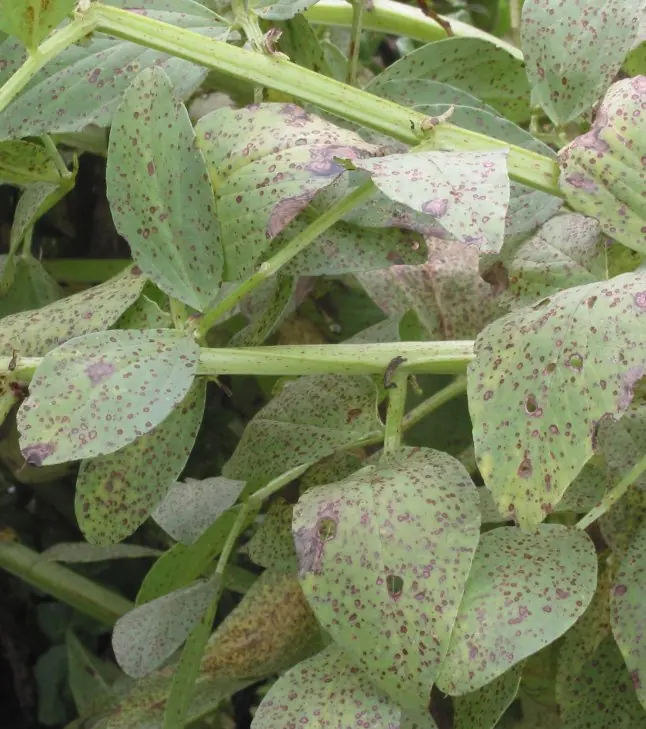
- The first sign is small, round, reddish-brown or chocolate-coloured spots, 1 to 3 mm across, scattered over the leaves.
- In dry weather the spots stay small and separate, and the plant carries on growing and flowering.
- In damp, humid weather the spots enlarge and join into dark brown blotches, and leaves blacken, wither and drop.
- Reddish-brown streaks appear on stems, and flowers turn brown and fall off without setting pods.
- Pods can develop brown spots, and in severe cases a grey, furry mould grows on dead tissue.
What it is often confused with
Rust
Broad bean rust has raised orange-brown powdery pustules that rub off on your fingers and usually appears later in warmer weather. Chocolate spot spots are flat and do not leave powder.
Botrytis
Grey mould (Botrytis cinerea) causes fluffy grey mould on soft, damaged growth of many plants. Chocolate spot is a related Botrytis that attacks healthy broad bean leaves with small brown spots first.
Leaf spot
Ascochyta leaf spot of beans makes larger, pale grey to brown spots with dark margins and tiny dark dots in the centre, rather than many small chocolate-brown spots.
When and where it is worst
Chocolate spot occurs throughout New Zealand and has been recorded as troublesome in Auckland, Hastings and Nelson, causing losses in wet seasons. It is worst in humid northern districts and in sheltered, damp gardens in Wellington, the West Coast and Southland, but any broad bean crop can be hit in a wet spring.
The fungus survives on old bean debris and on seed, and spreads by wind and rain splash. It is favoured by temperatures of roughly 15 to 22 °C with high humidity or leaves that stay wet for long periods, so late winter and spring, from August to November, are the main danger months. Plants under stress from acidic soil, poor drainage, low potassium or overcrowding are hit harder.
Plants it affects
These plants in our library list it as a problem to watch for.
How to prevent it
- Sow broad beans with plenty of space, about 20 cm between plants and 60 cm or more between rows, so air moves through the crop.
- Choose an open, sunny, well-drained site, and avoid sheltered, damp corners.
- Lime acidic soil before sowing and make sure the soil has enough potash, as both help plants resist the disease.
- Do not use high-nitrogen fertilisers on broad beans, as soft lush growth is more susceptible.
- Clear away and bin or bury old bean plants after harvest, and rotate broad beans to a new bed each year.
- Save seed only from clean, healthy plants, or buy fresh seed.
Organic control, step by step
- Pick off the worst-spotted lower leaves to improve airflow and remove spores, and bin them.
- Stake or string up plants so they stay upright and dry after rain.
- Spray copper as a protectant during humid spells in spring, covering both sides of the leaves and the stems, if the product you use lists beans.
- At the end of the season, remove all plant remains rather than leaving them on the bed.
Conventional control
- Copper sprays give some protection, but the home garden labels we checked list beans for other diseases, so use one only if the label you buy lists broad beans and chocolate spot.
- Copper oxychloride is registered for leaf spots on vegetables in New Zealand home gardens and helps protect broad beans in wet springs if the label covers your crop.
- Avoid spraying while bees are working the flowers, and spray in the evening when they have stopped foraging.
- Always read the label, check that broad beans and chocolate spot are listed, and keep to the withholding period before you pick.
Frequently asked questions
Can I eat broad beans from plants with chocolate spot?
Yes. The beans inside healthy pods are safe to eat. Discard any pods that are badly spotted or rotting.
Should I pull out plants with chocolate spot?
Not if they have only small scattered spots, as they will usually still crop well. Pull out and bin plants that have blackened and stopped flowering, so they do not spread spores to the rest of the row.
Why does chocolate spot get worse in spring?
Mild temperatures, frequent rain and dense, fast-growing crops in spring keep the leaves damp for long periods, which is exactly what the fungus needs to spread.
Are some broad bean varieties resistant to chocolate spot?
No variety is fully resistant, but some show better tolerance. Good spacing, good drainage and balanced feeding make more difference than variety choice in a home garden.
Related problems
Sources: Manaaki Whenua, Biota of New Zealand: Botrytis fabae; Royal New Zealand Institute of Horticulture, Plant Doctor: Spots on broad beans; Yates New Zealand, Liquid Copper Fungicide Concentrate. Identification and control follow these sources. Always read the product label before use.