Lemon tree borer: identify, prevent, control
Updated October 2026
Present all year inside the wood, with beetles flying and laying eggs from late spring through summer, and it is found throughout New Zealand except the driest districts.
Lemon tree borer is a native New Zealand longhorn beetle that has moved from native trees onto citrus and many other garden trees. The adult does little harm, but its white grubs spend one to two years tunnelling through branches, which kills twigs, weakens limbs and can let a whole branch snap. It is one of the most common reasons a backyard lemon, orange or grapefruit slowly goes into decline.
Oemona hirta
How to identify it
- The first sign is usually a small twig or shoot that suddenly wilts and browns while the rest of the tree looks healthy, often in early summer when young grubs ring the twig.
- On thicker branches you find neat round holes about 2 to 3 mm across, often in a line along the branch.
- Pale, powdery sawdust (the grub's frass) collects around the holes, in branch forks and on the ground or leaves below.
- If you cut into an affected branch you will see a clean, oval tunnel and possibly a creamy white, legless grub up to about 40 mm long with a dark head.
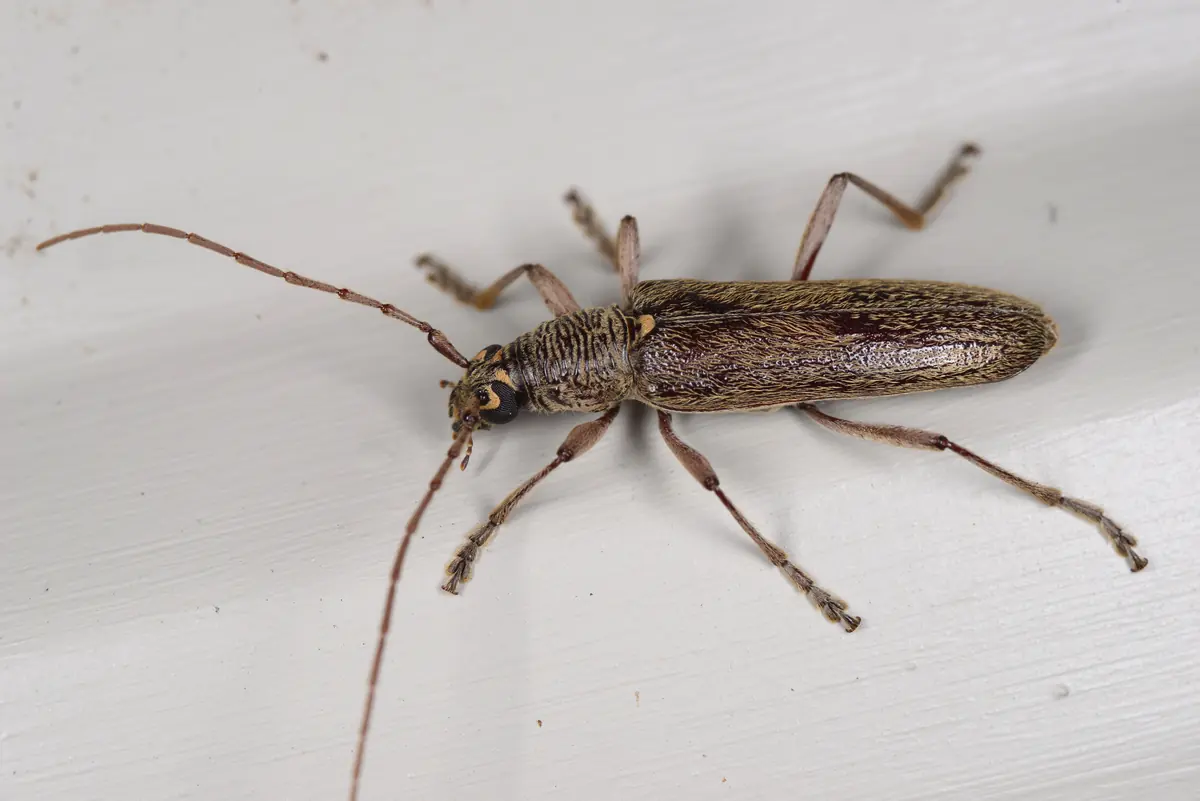
- The adult is a slender brown longhorn beetle about 15 to 25 mm long, with long antennae, fine pale hairs and orange hair tufts near the eyes, and it flies at night.
- Heavily infested limbs may snap in wind or under a crop of fruit.
What it is often confused with
Scale and sooty mould
Scale insects weaken citrus and leave black sooty mould on the leaves, but they do not make holes or sawdust. Borer damage always shows round exit holes and frass in the wood.
Dieback from root rot
Root problems make the whole tree yellow and thin out from the top. Borer kills individual twigs and branches, and you can find the holes on the dying wood.
When and where it is worst
Lemon tree borer lives throughout New Zealand and is a native insect, so it is always nearby wherever there are native shrubs and trees. It is a common pest on backyard citrus in Auckland, Northland, Waikato, the Bay of Plenty, Gisborne, Hawke's Bay, Wellington and Nelson, and it also attacks grapes, kiwifruit, apples, roses, wisteria and many ornamental and native hardwoods. It is less common in very dry districts.
Adult beetles emerge and fly from late spring to autumn, mostly from about November to March. Females lay single eggs in bark crevices, leaf joints and, above all, on fresh pruning cuts and wounds. The young grubs mine into small twigs over summer, then move down into thicker wood where they feed for one to two years before pupating near an exit hole.
Plants it attacks
These plants in our library list it as a problem to watch for.
How to prevent it
- Prune citrus between April and August, when beetles are not flying, because the smell of freshly cut citrus attracts egg-laying females.
- Seal larger pruning cuts with a pruning paste or sealant so beetles cannot lay eggs in the exposed wood.
- Avoid knocking the trunk with mowers and line trimmers, as bark wounds are another entry point.
- Check your trees each month in summer for wilting twigs and fresh frass, and cut off affected twigs early while the grub is still small.
- Remove and burn, bag or mulch away all citrus prunings and borer-infested wood rather than leaving it stacked near the tree.
- Keep trees well fed and watered, since vigorous trees recover far better from borer damage.
Organic control, step by step
- Cut off wilting twigs and infested small branches back into clean wood, and destroy them so the grubs cannot finish developing.
- On larger limbs you want to keep, push a length of fine wire or an old wound guitar string firmly into each active hole and work it along the tunnel to kill the grub.
- Fill treated holes with a soft putty or sealant so you can see which holes are new next time you check.
- A pyrethrum (pyrethrins) spray injected into an active hole until it runs out of nearby holes can kill the grub, used as the label directs.
- Leave native parasitic wasps alone, as the ichneumon wasp Xanthocryptus novozealandicus attacks borer grubs inside the wood.
Conventional control
- Sprays over the canopy do not reach borer grubs inside the wood, so there is no general spray to apply to the tree.
- Borer injector products sold in New Zealand garden centres are applied directly into each active hole with a fine nozzle, then the hole is sealed.
- Treat holes when you see fresh frass, and recheck every few weeks through summer for new activity.
- Read the label before you buy or use any product, check that citrus or fruit trees are listed, and keep to the withholding period before picking.
Frequently asked questions
How do I know if the borer is still active?
Brush away old frass, seal or mark the holes, and look again a week or two later. Fresh pale sawdust pushed out of a hole means a live grub is still feeding inside.
When is the best time to prune citrus to avoid borer?
Prune between April and August, when the beetles are not flying. Summer pruning releases a citrus scent that draws females to lay eggs on the fresh cuts.
Can a lemon tree recover from borer?
Yes, if you remove infested twigs early and deal with grubs in the main limbs. Trees with borer in the trunk at ground level and many dead limbs may be better replaced.
Is lemon tree borer only a problem on lemons?
No. Despite the name it attacks all citrus, including oranges, grapefruit, tangelos, cumquats and pomelo, plus many other fruit trees, vines and native hardwoods.
Related problems
Sources: NZ Farm Forestry Association, Lemon-tree borer (Oemona hirta); Yates NZ, Lemon tree borer; Kiwicare, Citrus tree borer. Identification and control follow these sources. Always read the product label before use.