
White rust: identify, prevent, control
Updated October 2026
Worst in cool, damp weather in spring and autumn, when leaves stay wet overnight, in gardens throughout New Zealand.
White rust, also called white blister, is caused by water moulds that form raised white pustules on leaves and stems. Each kind is specific to its host plants: Pustula tragopogonis attacks salsify, scorzonera and other daisy-family plants and is present in New Zealand, while Albugo candida attacks radish, turnip and other brassicas. The white rust of kang kong (water spinach), Albugo ipomoeae-aquaticae, is recorded as absent from New Zealand, so a suspected case on kang kong should be reported to MPI.
Pustula tragopogonis, Albugo candida, Albugo ipomoeae-aquaticae
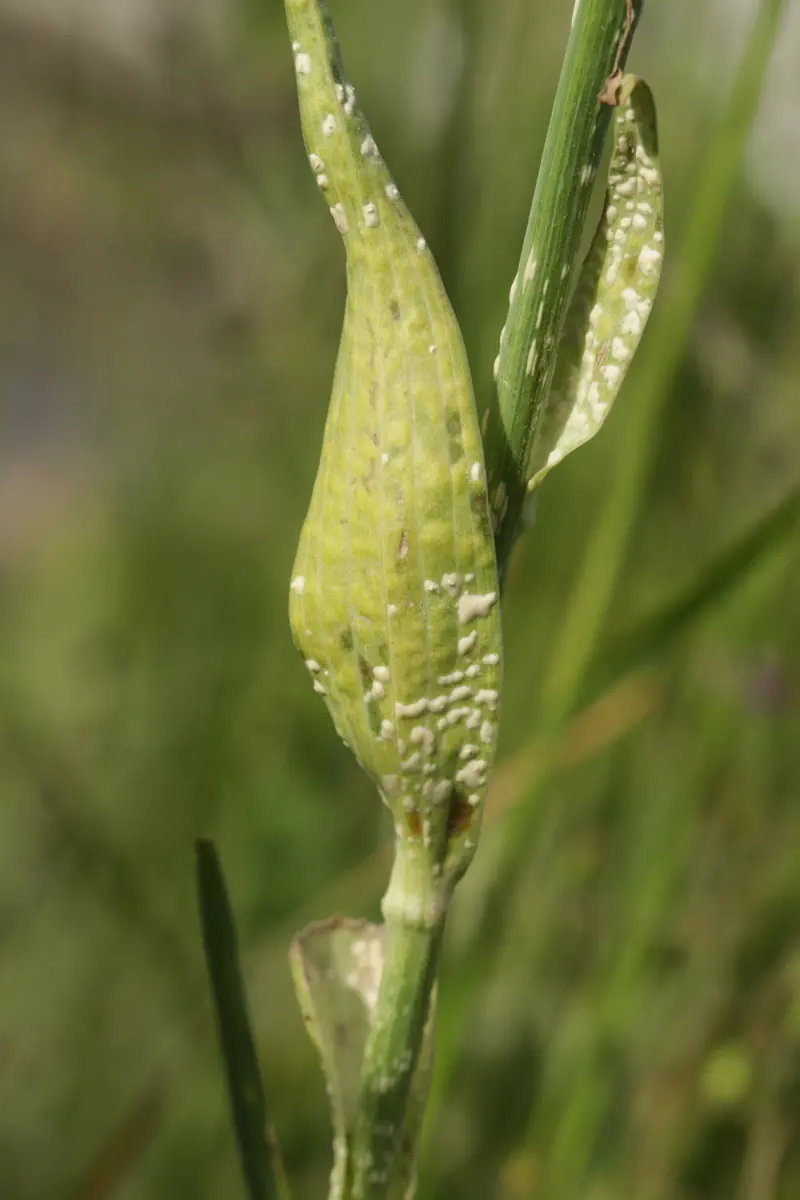
How to identify it
- The first sign is pale yellow or light green patches on the upper side of the leaf.
- Underneath those patches, small raised blisters form that are shiny and white, like drops of paint or chalk.
- The blisters burst to release a white, powdery mass of spores, and neighbouring blisters may join into larger white patches.
- On salsify and scorzonera, blisters also appear on leaf stalks, stems and flower buds, and badly affected leaves twist, yellow and die back.
- On brassicas, white rust can cause swollen, distorted stems and flower heads, sometimes called stagheads.
- On kang kong, look for yellow spots on the upper leaf with white blisters below and swollen, distorted stems.
What it is often confused with
Rust
True rusts have orange, brown or black powdery pustules. White rust pustules are white and chalky, and the disease is caused by a water mould rather than a rust fungus.
Powdery mildew
Powdery mildew is a flat, white, dusty film on the leaf surface that can be wiped away. White rust forms raised blisters inside the leaf, mostly on the underside, which do not wipe off.
Downy mildew
Downy mildew makes a soft, grey or purplish fuzz under yellow leaf patches. White rust blisters are firm, raised and bright white.
When and where it is worst
White rust of salsify and its relatives has been recorded across New Zealand, including on salsify (Tragopogon porrifolius) and on the related wild goat's beard, and on native and introduced daisy-family plants. Brassica white rust is common in cool, damp districts such as Southland, Otago, the West Coast and Wellington, as well as in winter and spring crops further north.
The water moulds spread by wind and rain splash, and infection needs leaves to stay wet for several hours at cool to mild temperatures, roughly 10 to 20 °C. Resting spores survive in old plant debris in the soil, and wild relatives such as goat's beard, shepherd's purse and wild turnip carry the disease between crops.
Plants it affects
These plants in our library list it as a problem to watch for.
How to prevent it
- Rotate salsify and scorzonera, and keep brassicas such as radish and turnip out of the same bed for at least three years.
- Pull out wild goat's beard, shepherd's purse and wild brassica weeds near your vegetable beds.
- Space plants well and water at the base in the morning so leaves dry quickly.
- Clear away and bin crop remains at the end of the season instead of digging them in.
- Buy kang kong plants and cuttings from reputable New Zealand suppliers rather than importing plant material or bringing it in from overseas.
Organic control, step by step
- Pick off and bin the first leaves with blisters as soon as you see them.
- Remove badly affected plants completely so they do not spread spores to the rest of the bed.
- Improve airflow by thinning crowded rows and removing weeds between plants.
- If white rust appears on kang kong, do not spread or share the plants; bag them, keep them aside and call MPI first.
Conventional control
- We could not find a fungicide registered for white rust on salsify, scorzonera or kang kong in New Zealand home gardens, so control relies on hygiene and rotation.
- Copper products registered for downy mildew on brassicas may offer some protection where white rust is also present, but use them only on crops and diseases the label lists.
- For suspected white rust on kang kong, call the MPI pest and disease hotline on 0800 80 99 66 before you treat or remove the plants.
- Always read the label, check that your crop and disease are listed, and keep to the withholding period before you harvest.
Frequently asked questions
Is white rust the same as rust?
No. Rusts are true fungi with orange or brown spores, while white rust is a water mould related to downy mildew. The two need different approaches, and rust sprays may not work on white rust.
Can white rust spread from my salsify to my cabbages?
No. Each kind of white rust is specific to its own plant family. The salsify kind stays on salsify, scorzonera and related daisy-family plants, and the brassica kind stays on brassicas.
Why should I report white rust on kang kong?
The white rust of kang kong is recorded as absent from New Zealand. Reporting a suspected case to MPI on 0800 80 99 66 helps keep a new disease out of the country.
Can I still eat leaves with white rust?
The disease is not harmful to people, so lightly affected leaves can be eaten after you remove the spotted parts. Badly blistered leaves are not worth keeping.
Related problems
Sources: Manaaki Whenua, Biota of New Zealand: Pustula tragopogonis; New Zealand Organisms Register, Albugo ipomoeae-aquaticae (status: absent); Pacific Pests, Pathogens and Weeds, Cabbage white rust. Identification and control follow these sources. Always read the product label before use.