Get the basics right and your flock almost feeds itself. A complete feed matched to each bird's age does most of the work, with grit, shell and clean water doing the rest.
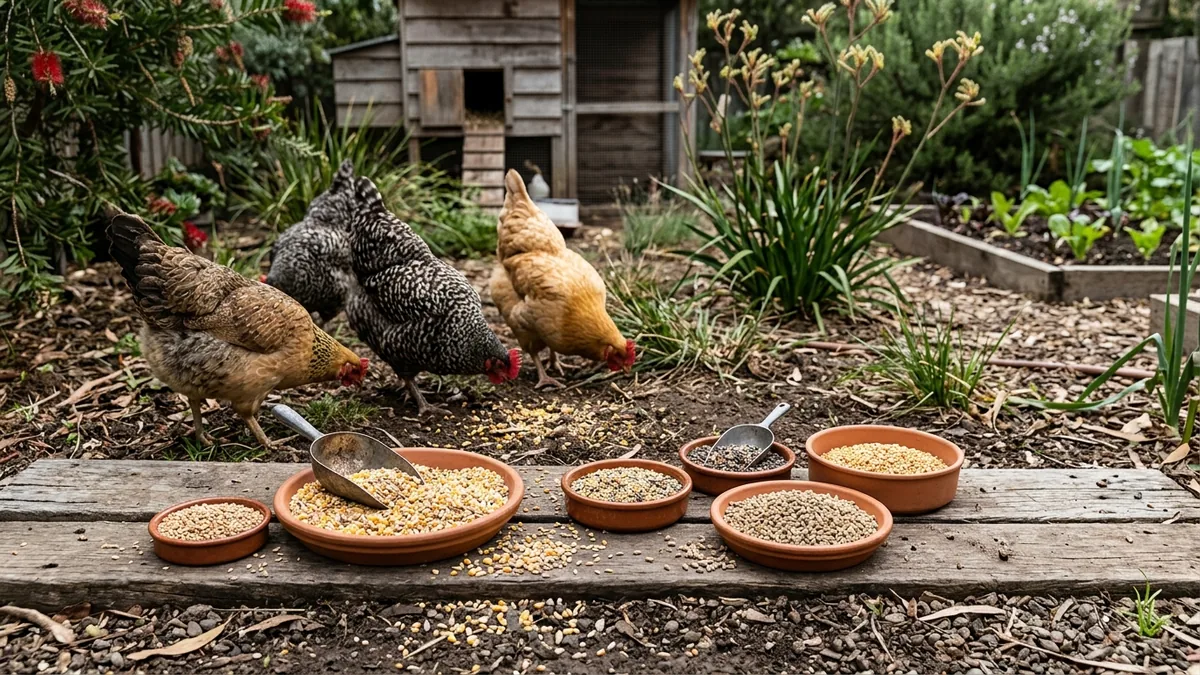
Feeding chickens well is simpler than it looks. A good commercial feed is formulated to supply the right balance of protein, energy, minerals and vitamins for a bird's life stage, so the single most important decision you make is choosing the right complete feed and matching it to the age of your birds. Everything else, the treats, the greens, the shell grit, sits on top of that foundation.
Birds eat to meet their energy needs, so keep good feed available and let them help themselves. If you fill the diet with low-value treats, hens eat less of the balanced feed and laying, shell quality and condition all suffer. Get the base feed right and the rest is detail.
This page covers nutrition and feed types. If you would rather mix or supplement your own ration and work out the cost, our homemade chicken feed tool gives you a recipe and a price per kilogram to compare against bagged feed.
Pick a life stage to see the feed type, the protein target and a quick give-and-avoid list. Values are realistic ranges for backyard flocks. Nothing is saved, and it works offline.
Almost every backyard flock is fed on three feeds across a bird's life. They differ mainly in protein and calcium, and switching at the right time matters.
The one switch people get wrong is moving young birds onto layer feed too early. Wait for point of lay. Until then, grower feed plus the steady protein of starter behind it is exactly what a pullet needs.
These three are easy to confuse, and they do different jobs.
Offer shell grit and stone grit in their own dishes rather than mixed into the feed, so each bird can self-select. Do not feed shell grit to chicks or non-laying birds as a calcium source.
Chickens love a treat and a few scraps are part of the fun of keeping them, but treats are not balanced feed. Keep all treats and scraps combined to about 10 percent of the daily diet so the complete feed still carries the load.
Good options in moderation include leafy greens, weeds, vegetable trimmings, cooked pumpkin, whole grains, a little cooked rice or pasta, and the occasional handful of mealworms in a moult. Poorer choices are anything salty, sugary, oily or fried, large amounts of bread, and lawn clippings in big wads that can pack the crop. Greens and garden trimmings are the safest everyday extras.
Most foods are fine in moderation, but a short list is genuinely risky and worth memorising.
Clean, fresh water should always be available. A laying hen drinks far more than people expect, and water needs climb sharply in warm weather. A bird that cannot drink stops eating, and laying falls within a day or two.
Keep drinkers in the shade, refresh them daily, and add an extra drinker in summer or during a heatwave. Scrub them regularly so algae and slime do not build up. In a cold snap, check the water has not frozen.
| Life stage | Feed type | Protein | Calcium | Notes |
|---|---|---|---|---|
| Chicks (0 to 6 weeks) | Chick starter crumble | 18 to 20% | Low, none added | Medicated optional; fresh water; no shell grit |
| Pullets / growers (6 to 18 weeks) | Grower / pullet feed | 15 to 16% | Low | Do not feed layer feed yet; high calcium harms growing kidneys |
| Laying hens (point of lay on) | Layer pellet or mash | 16 to 17% | 3.5 to 4% | Free-choice shell grit; clean water always |
| Roosters and non-layers | Maintenance / grower feed | 14 to 16% | Low | Avoid long-term high-calcium layer feed; offer calcium free-choice |
| Broody / moulting hens | Higher-protein feed | 18 to 20% | Keep calcium for layers | Feathers are about 85% protein; extra water during a moult |
The free Planting Season app and its Poultry and Flock tracker let you log what each bird eats and lays, so you can see how a feed change shows up in the egg basket. It keeps chickens, ducks and quail in one place, and works offline.
A standard laying hen eats roughly 100 to 150 grams of complete layer feed a day, a little more in cold weather and a little less for bantams. Keep feed available so birds can eat to appetite. Scratch and treats are extra and should stay under about 10 percent of the diet so they do not dilute the balanced feed.
No. Layer feed carries about 3.5 to 4 percent calcium for eggshells, which is far too much for growing chicks and pullets. Excess calcium can damage their developing kidneys. Feed chick starter to about 6 weeks, then grower or pullet feed, and only switch to layer feed at point of lay, around 18 weeks or the first egg.
Birds that range on soil usually pick up small stones naturally, so they may not need added insoluble grit. Confined birds, or any bird eating grain, scraps or grass rather than only complete feed, need free-choice grit to grind food in the gizzard. Soluble shell grit for eggshells is a separate thing and laying hens should always have it available.
No. Scraps are unbalanced and cannot supply the steady protein, calcium and vitamins hens need to lay well and stay healthy. Use a complete feed as the base of the diet and treat scraps as a top-up, kept to about 10 percent. Birds fed mostly scraps lay fewer eggs, get thin-shelled eggs, and can become overweight on the wrong scraps.
Soluble shell grit, such as oyster shell or crushed shell, dissolves in the bird and supplies calcium for eggshells. Insoluble grit is small hard stones that sit in the gizzard and grind food. They do different jobs, so offer both free-choice in separate dishes rather than mixing them into the feed.
No. Scratch grains are mostly energy with little protein or calcium, and dried mealworms are a high-protein treat, not a balanced ration. Both are fine in small amounts but neither replaces complete feed. Treat them as a top-up under about 10 percent of the diet so the balanced feed still does the work.
In small amounts. A little cooked rice or plain bread as an occasional treat is fine, but they are filling with little nutrition, so large amounts crowd out balanced feed and can cause weight gain. Avoid mouldy bread entirely. Keep all treats combined under about 10 percent of the daily diet.
It is optional. Medicated starter usually contains a coccidiostat that helps protect chicks against coccidiosis, a common gut parasite, in their first weeks. It is useful where coccidiosis is a known risk or chicks are raised in damp, crowded conditions. If your chicks are vaccinated against coccidiosis, use unmedicated starter so the medication does not interfere with the vaccine.
Log what your flock eats and lays in the free Poultry module and see what really works in your yard.