
How to Grow Courgettes (Zucchini) in New Zealand: When to Plant
Updated October 2026
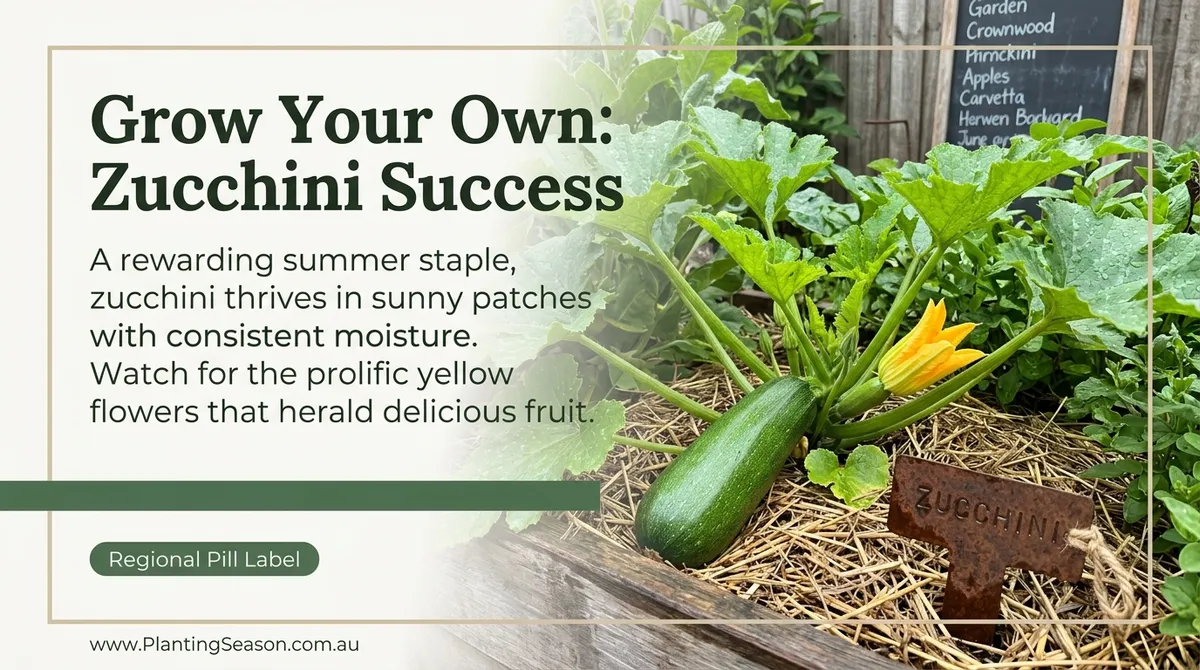
Zucchini (the same plant most New Zealanders call courgette, as the British and French do) is one of the most productive crops you can grow. Sow direct from October once frost has passed in the warm north, or raise seedlings inside in cooler regions. One or two plants is usually plenty. Pick young and often to keep them producing, and water at the base to keep powdery mildew at bay.
How many zucchini plants should I grow?
Enter your household size. Zucchini is wildly productive, so the answer is almost always fewer plants than you would guess.
What it looks like as it grows


🌱 Plant profile: Zucchini, with sowing times for your region, companion plants and common pests.
Position and soil
Zucchini wants full sun and rich, well-fed soil. It is a hungry, thirsty plant. Dig in plenty of compost and aged manure before planting so the bed holds moisture and feeds the plant through a long season. Good drainage matters too, so a raised mound or bed suits it well.
When to Plant Courgettes in Your Region
Timing matters here, where the warm north and the cooler south are weeks apart. Zucchini needs warm soil of around 18 degrees Celsius, so wait until frost has passed.
Courgettes go in from October in the warm north but not until December in the far south. These are the sowing and planting months for each region from our planting data. Each region links to its vegetable planting calendar, and the Zucchini plant page has spacing, companions and care notes for your region.
| Region | Sow or plant out | Local note |
|---|---|---|
| Northland | October to January | |
| Auckland | October to January | |
| Waikato & Bay of Plenty | October to January | |
| Central North Island | November and December | The average last frost is around 15 October, so sowing waits until November. |
| Wellington & Lower North Island | November to January | |
| Nelson & Marlborough | November to January | |
| Canterbury | November and December | The average last frost is around 10 October, so sowing waits until November. |
| Otago & Southland | December | The average last frost is around 25 October, so sow in December. |
| Central Otago | December | The average last frost is around 5 November, so sow in December. |
Sowing and planting
Build a planting mound or hill by mixing compost and aged manure into the soil. Mounds drain well and warm faster in spring. Sow 2 to 3 seeds per mound, around 2 cm deep, and thin to the single strongest seedling once they have a couple of true leaves. Seeds germinate in about 7 days, and plants are ready to harvest in roughly 60 days. In cooler regions, raise seedlings inside 3 to 4 weeks before your last frost and transplant once the weather settles.
Courgettes From Seed or Seedlings
Courgettes are easy from seed. Our plant data puts emergence at about 7 days in soil between 18 and 30°C. Sow two seeds per mound about 2 cm deep and keep the stronger one. Sowing direct suits the warm north, where sowing starts in October.
Seedlings give you a head start where spring is cool or short. You can raise your own inside, as above, or buy punnets, which are widely available in spring. Plant them out in the months the table shows for your region.
Planting courgette seedlings
- Build a mound of soil mixed with compost and aged manure in full sun, allowing 80 to 100 cm between plants.
- Wait until frost has passed and the soil is warm. Our frost dates page gives the average last frost for your region.
- Water the punnet first, then ease the seedling out with as much soil around the roots as possible.
- Plant it at the same depth it sat in the punnet, firm the soil gently and water it in well.
- Water at the base rather than over the leaves while it settles in, and mulch around the base once it is growing.
Spacing
Give each plant room. Space bush varieties 80 to 100 cm apart, roughly one square metre per plant. They grow into large, sprawling plants, and good spacing keeps air moving through the leaves, which is your first defence against powdery mildew. Climbing types such as Tromboncino can be trained up a trellis to save ground space.
Growing Courgettes in Pots
Courgettes can be grown in a container, but our plant data rates them only partly suited to pots, because a bushy plant needs plenty of root room and steady water. Use a pot of at least 50 cm filled with a rich potting mix, and grow one plant in each pot, since a single plant needs about 80 cm of space in the garden.
A compact bush variety such as Golden suits a pot best. Tromboncino is a vigorous climbing vine and is better trained up a trellis in the ground. Pots dry out quickly in summer, so water deeply at the base whenever the mix starts to dry, keep the leaves dry to limit mildew, and switch to a potassium feed once fruit sets.
Watering and feeding
Zucchini are heavy feeders and need consistent water. Water deeply at the base of the plant, never over the leaves, and keep the soil evenly moist rather than swinging between dry and soaked. Mulch around the base to hold moisture. Feed every two to three weeks with a balanced liquid fertiliser once flowering starts to keep the fruit coming.
Pollination
Zucchini produce separate male and female flowers on the same plant. Male flowers appear first on thin, straight stems. Female flowers have a small swelling, the baby courgette, behind the petals. Bees move pollen from male to female. If a female flower is not pollinated, the small fruit behind it yellows, shrivels at the blossom end, and drops off. This poor fruit set is the most common complaint and is often mistaken for disease.
To hand pollinate, pick a male flower, peel back the petals, and dab the pollen-covered stamen onto the stigma in the centre of a female flower. Do it in the morning when the flowers are freshly open.
How Long Do Courgettes Take to Grow?
Courgettes are quick. Our plant data allows about 60 days from sowing to the first fruit, and seedlings appear in about 7 days. Once a plant starts fruiting it keeps going for as long as you keep picking, until powdery mildew, which is almost guaranteed by late summer, slows it down.
Your sowing date decides when picking starts. An October sowing in the warm north can be picked from around December, while a December sowing in Otago, Southland or Central Otago starts cropping from around February. Staggering two sowings four to six weeks apart, as the tip above suggests, spreads the harvest.
Best zucchini varieties for NZ
| Variety | Type | Notes |
|---|---|---|
| Black Beauty | Bush, dark green | Classic heavy and early cropper. Egmont Seeds, Kings Seeds, Mitre 10. |
| Costata Romanesco | Bush, ribbed green | Italian heirloom with excellent nutty flavour, good for flowers too. Kings Seeds, Egmont Seeds. |
| Golden | Bush, yellow | Bright yellow fruit on a compact bush, mild and tender, easy to spot in the foliage. Egmont Seeds, Kings Seeds. |
| Round (Tondo) | Bush, round | Tennis-ball shaped fruit, ideal for stuffing and roasting whole. Kings Seeds. |
| Tromboncino | Climbing, long curved | Vigorous climber for a trellis, firm flesh and few seeds. Kings Seeds, Egmont Seeds. |
Companion planting
Grow zucchini near nasturtium, corn, beans, and marigold. Flowers nearby draw in the bees that pollinate your fruit.
Pests and problems
Powdery mildew
White powder over the leaves is almost guaranteed by late summer. Water at the base, improve airflow with good spacing, and remove the worst leaves. A weekly spray of one part milk to nine parts water can slow it. See our powdery mildew guide.
Fruit rotting at the tip
Tiny fruit that rots and drops at the blossom end is poor pollination, common in cool or wet spells. Hand pollinate with a male flower, or wait for the bees in better weather.
28-spotted ladybird and aphids
The 28-spotted ladybird and its larvae skeletonise leaves into a lacy look; pick them off by hand. Aphids and whitefly cluster on soft growth; hose them off and encourage predators. See our NZ pest and disease guide for organic control.
Harvesting
Pick zucchini young at 15 to 20 cm for the best flavour, and check plants every two days during peak production. Fruit grows fast and can double in size overnight. Leave it too long and you get a marrow: watery, tough-skinned, and full of seeds, which also slows down new fruit. Cut the stem cleanly with a sharp knife rather than pulling.
When to pick courgettes
Pick while the fruit is young and glossy, at around finger to hand length and no more than 15 to 20 cm. Cut it with a short stem attached. A single missed fruit swells fast and slows new fruit forming, so a quick check every two days in summer keeps the plant cropping.
Courgettes keep in the fridge crisper for up to 5 days. For a glut, grate them and freeze them in portions for baking.
Frequently asked questions
How many zucchini plants per person do I need?
Far fewer than most people think. Two to three plants feed most households for the whole summer, no matter how many people are in the family. Even one healthy plant produces a steady supply. Planting one per person almost always leads to a glut.
Why are my zucchini rotting at the end?
Small fruit that yellows and rots at the blossom end before it develops is almost always poor pollination, not a disease. The female flower was not pollinated, so the tiny fruit behind it shrivels and drops off. It is common in cool or wet weather. Hand pollinate with a male flower.
What can I do with a glut of zucchini?
Grate and freeze it in portions for baking, make relish or pickles, bake a zucchini slice or loaf, stuff and roast the larger ones, or spiralise it. The best fix is prevention: pick young and often, and grow only two or three plants.
When is the best time to plant zucchini in New Zealand?
Sow or plant courgettes once frost has passed and the soil is warm. Northland, Auckland, Waikato and Bay of Plenty sow from October to January. Wellington and Nelson and Marlborough sow from November to January, and the Central North Island and Canterbury in November and December. Otago, Southland and Central Otago sow in December. Check the table above for your region.
How much space does a zucchini plant need?
Allow about one square metre per plant, spacing bush varieties 80 to 100 cm apart. They grow large and need room for airflow, which also helps prevent powdery mildew.
Is zucchini the same as courgette?
Yes. Zucchini and courgette are two names for the same plant. Both are sold in New Zealand and grown in exactly the same way.
Where can I buy zucchini seeds or plants in NZ?
Try Egmont Seeds, Kings Seeds, or your local Mitre 10 and garden centre. Seedlings are widely available in spring.
Can you grow courgettes in pots?
Yes, in a large pot. Our plant data calls for a container of at least 50 cm and rates courgettes only partly suited to pots, so grow one compact bush plant, such as Golden, in each pot and water it deeply whenever the mix starts to dry.
How long do courgettes take to grow?
About 60 days from sowing to the first fruit, according to our plant data, with seedlings appearing in about 7 days in warm soil. Pick young and often and the plant keeps cropping through summer.
Should I sow courgette seeds direct or plant seedlings?
Both work. Sowing two seeds per mound about 2 cm deep suits the warm north, where sowing starts in October. In cooler regions, seedlings raised inside 3 to 4 weeks before your last frost, or bought in punnets, give you a head start. Plant them out in your region's months once frost has passed.
How big should courgettes be when you pick them?
Pick them young and glossy, at around finger to hand length or 15 to 20 cm. Larger fruit turn into watery, seedy marrows and slow the plant down, so check every two days in summer.
Plant profile
The zucchini profile has sowing times for your region, companion plants and common pests.