
Psa (kiwifruit vine disease): identify, prevent, control
Updated October 2026
Spreads in cool, wet, windy weather in spring and autumn, with leaf spots from September to November and red ooze on canes in late winter and spring, in all North Island kiwifruit districts.
Psa, sometimes listed as bacterial canker (Psa), is a bacterial disease of kiwifruit caused by Pseudomonas syringae pv. actinidiae. The virulent strain Psa-V was found near Te Puke in November 2010 and has since spread to almost every North Island kiwifruit district, while the South Island is still free of it. It causes leaf spots, flower bud rot, cane dieback and sometimes vine death, and it is managed under a national plan run by Kiwifruit Vine Health (KVH).
Pseudomonas syringae pv. actinidiae (Psa-V)

How to identify it
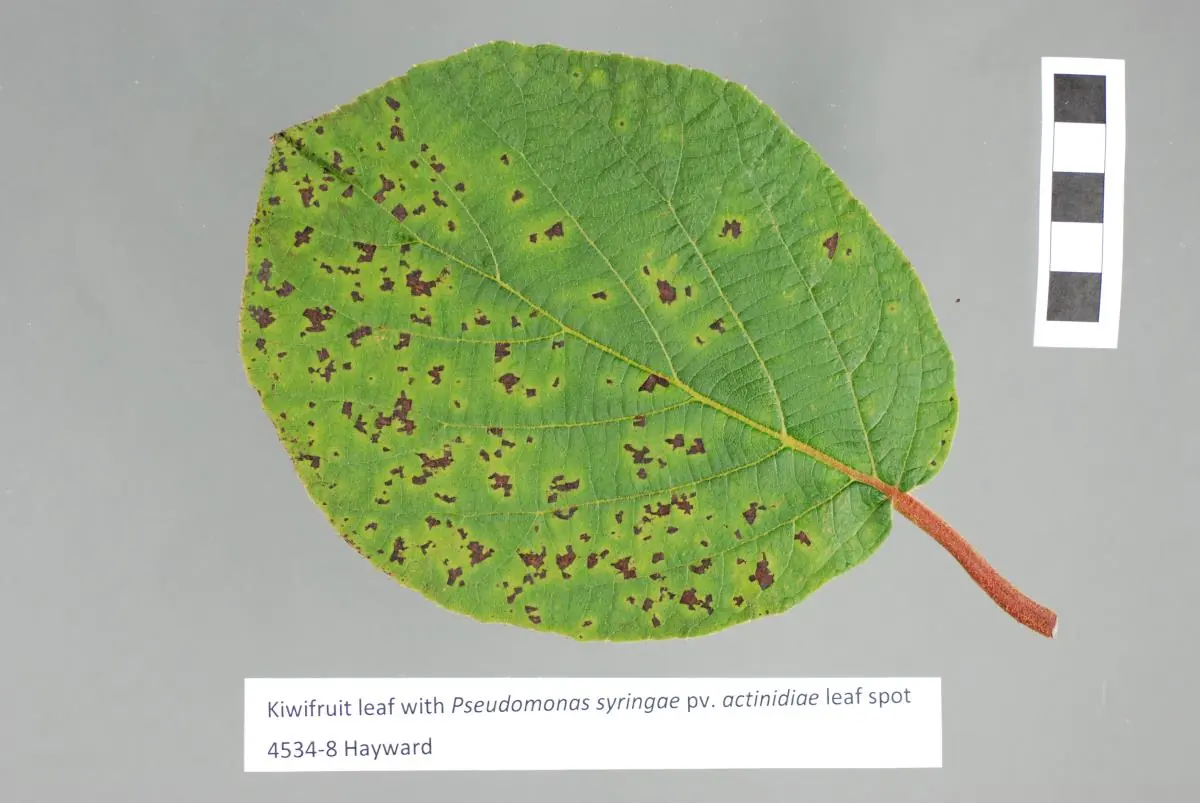
- In spring, small dark brown to black angular spots appear between the leaf veins, sometimes with a pale yellow halo and often in a peppery scatter across the leaf.
- Flower buds may turn brown, dry up and drop before opening.
- In late winter and spring you may see red, orange or sometimes white ooze (exudate) coming from cane nodes, pruning cuts, leaders or the graft union.
- Shoots wilt and curl, and in summer whole canes or leaders can collapse, with shrivelled fruit left hanging.
- Under the bark of affected canes the tissue turns brown and water-soaked, and vines can die back to the trunk in bad cases.
- Gold (yellow-fleshed) varieties and many male pollinator vines are usually affected more than green Hayward.
What it is often confused with
Bacterial canker of stone fruit
Stone fruit canker is caused by different strains of the same bacterial species and only affects cherries, plums, apricots and their relatives. It does not move onto kiwifruit.
Leaf spot and wind damage
Wind and sunburn leave brown leaf edges and torn patches rather than angular spots between the veins. Fungal leaf spots are usually round, while Psa spots are angular and often haloed.
Leafroller damage
Leafroller caterpillars chew holes and web leaves together, and they can scar fruit. Psa causes spots and ooze without chewing or webbing.
When and where it is worst
Psa-V is now present in almost every kiwifruit growing district of the North Island, including Northland, Auckland, Waikato, the Bay of Plenty, Gisborne and Hawke's Bay. The South Island, including the Nelson, Motueka and Golden Bay kiwifruit districts, is still free of Psa-V, and KVH runs regular surveys and movement controls to keep it that way.
The bacteria spread in rain, wind and on tools, and they get into vines through leaf scars, pruning cuts, frost and hail damage and natural openings. Cool, wet weather, especially in spring (September to November) and again in autumn, gives the most new infection. Frost, hail and storms are often followed by a jump in symptoms.
Plants it affects
These plants in our library list it as a problem to watch for.
How to prevent it
- Buy kiwifruit plants only from a registered nursery, and never bring in cuttings, budwood or plants from someone else's vine.
- Do not move any kiwifruit plants, cuttings, budwood or pollen from the North Island to the South Island, as the national pathway plan controls this movement.
- Prune in dry weather and clean secateurs and saws with methylated spirits or a disinfectant between vines and between cuts on infected wood.
- Avoid big pruning cuts and leaf damage just before wet, windy weather, and shelter vines from strong wind where you can.
- Keep vines evenly fed and watered without pushing soft, excess growth with heavy nitrogen.
- If you are planting a new kiwifruit vine, ask the nursery about varieties with better Psa tolerance, as green Hayward types are generally less affected than the older gold Hort16A.
Organic control, step by step
- Check the vine every couple of weeks in spring and autumn for leaf spots, browning buds and red ooze.
- Cut out any cane or shoot with ooze or dieback well below the visible damage in dry weather, and bag or burn it rather than composting.
- Clean tools after every cut on an infected vine and before moving to another plant.
- Apply copper sprays to protect leaf scars after harvest and at leaf fall, and again at bud burst in wet springs, as copper is allowed in organic growing.
- If a vine is heavily infected and keeps dying back, cut it down and remove it, because it will keep spreading bacteria to nearby vines.
Conventional control
- Copper products (such as copper hydroxide or copper oxychloride) are the main protective spray for home vines, applied after pruning, at leaf fall and from bud burst in wet weather.
- Use copper at the lower rates once leaves are out, as kiwifruit leaves and fruit can be marked by strong copper sprays.
- Commercial growers have access to other products under KVH and Zespri programmes, but these are not sold for home use, so keep to copper and good hygiene.
- Read the label before you buy or spray, check that kiwifruit is listed, and keep to the withholding period before picking.
Frequently asked questions
Do I have to report Psa on a backyard kiwifruit vine?
In the North Island Psa-V is already widespread, so you do not need to report a typical case on a home vine, though KVH is always happy to advise on 0800 665 825. In the South Island, any suspected Psa should be reported to KVH straight away, and you can also call the MPI pest and disease hotline on 0800 80 99 66.
Can I still eat fruit from a vine with Psa?
Yes. Psa does not affect people, and fruit that ripens normally is safe to eat. Infected vines often crop less, and fruit on collapsed canes will shrivel.
Will Psa kill my kiwifruit vine?
It can, especially gold varieties and young vines, but many green Hayward vines live with it for years if you cut out infected wood and protect them with copper. A vine that dies back to the trunk each year is best removed.
Is Psa the same as bacterial canker on my cherry tree?
No. Both are caused by Pseudomonas syringae, but they are different strains with different hosts. Psa only infects kiwifruit, and cherry canker only infects stone fruit. See our bacterial canker page for stone fruit.
Related problems
Sources: Kiwifruit Vine Health (KVH), Psa-V; KVH Information Sheet, Identification of Psa-V symptoms; KVH, Watchful eyes to confirm South Island freedom from Psa-V; Science Learning Hub, Kiwifruit: learning to live with Psa. Identification and control follow these sources. Always read the product label before use.