
Balcony Garden: How to Grow Vegetables, Herbs and Fruit on a Balcony
Updated November 2026
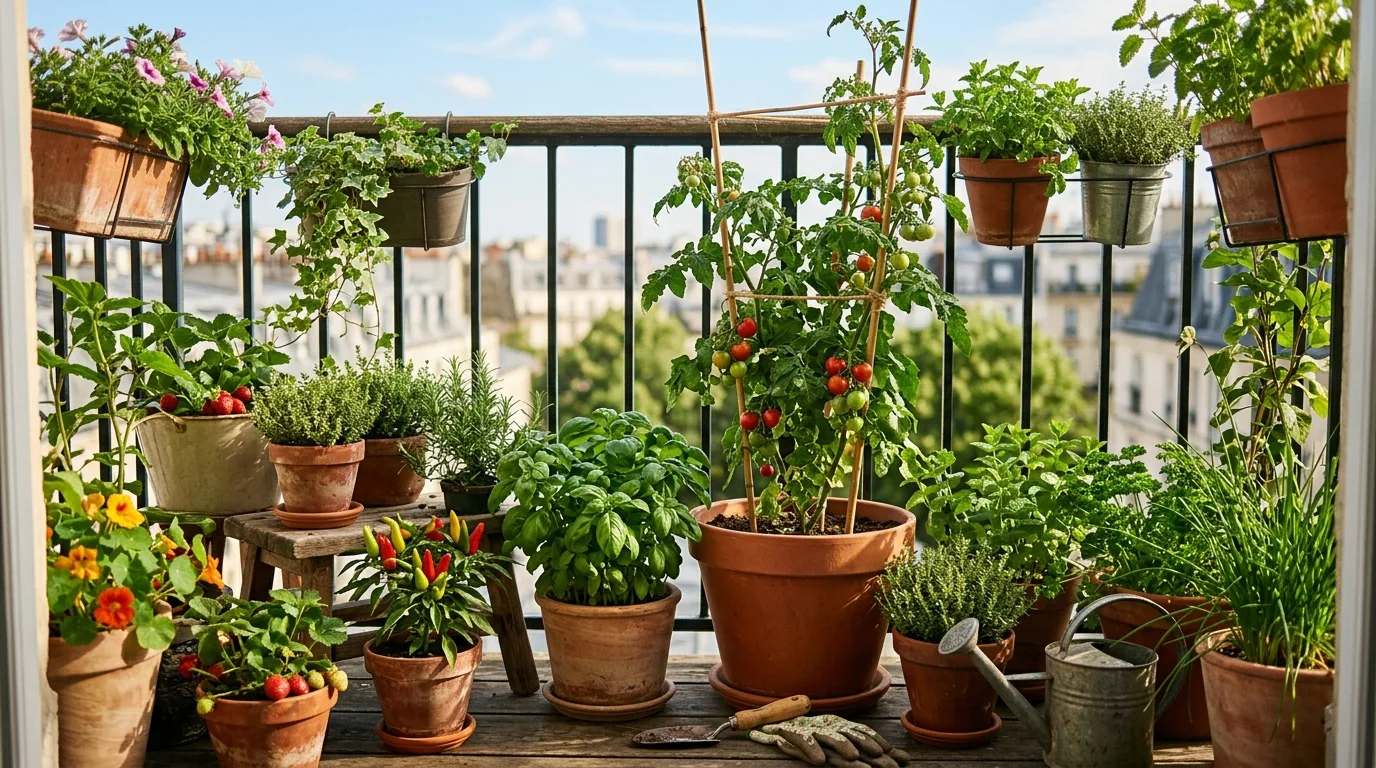
A balcony garden works when three things line up: enough sun for the crops you pick, pots big enough to hold water through a hot day, and a watering routine you can keep up. This guide walks through each one, gives a pot size table built from our plant data, and finishes with three balcony plans you can copy. The months for every crop depend on your region, so each plan links to the crop guides that list them.
Quick answer
- Count your sun hours first: 6 or more suits tomatoes, chillies and capsicums, 3 to 5 suits salad, herbs and root crops.
- Use the biggest pots the floor can carry, and always use potting mix, never garden soil.
- Expect to water most pots every day in summer, and feed lightly every week or two.
- Check the weight limit, wind exposure and your lease or building rules before you buy a single pot.
Step 1: work out your light
Sun decides what you can grow, so spend one clear day watching the balcony. Note which hours it gets direct sun at about 9 in the morning, noon, and 3 in the afternoon, and remember that railings, overhead balconies and neighbouring buildings can shade a space that looks sunny on the plan. Light changes with the seasons too: the sun sits lower in winter, so a balcony that is shady in June may be sunny in December.
| Balcony faces | Typical sun | What suits it |
|---|---|---|
| North | Sun for most of the day, all year. The best aspect in New Zealand. | Fruiting crops: tomatoes, chillies, capsicum, beans. In midsummer give the plants afternoon shade cloth if leaves scorch. |
| East | Morning sun, usually 4 to 6 hours, and gentle. | Salads, herbs, strawberries, peas, spring onions. Chillies and cherry tomatoes will crop but ripen later. |
| West | Afternoon sun, 4 to 6 hours or more in summer, and hot against a wall. | Heat lovers such as chillies, rosemary, thyme and oregano. Keep leafy crops in the shade of taller pots. |
| South | Little direct sun, often under 3 hours, mostly in summer. | Mint, parsley, chives, lettuce, rocket, silverbeet and other leafy crops. Choose compact varieties. |
These are rules of thumb for the southern hemisphere. Your own count of sun hours beats the table whenever the two disagree.
Step 2: check weight, wind and the rules
- Weight. Wet potting mix is heavy, and a large pot can weigh 30 kg or more once watered. Spread big pots near the walls or over a load-bearing edge rather than clustering them in the middle, and ask your building manager if you are unsure of the limit.
- Wind. Wind two or more storeys up dries pots quickly and snaps tall stems. Use heavy, wide-based pots, tie tomatoes to a firm stake, and put a trellis or screen on the windward side.
- Falling hazards. Keep rail planters on the inside of the railing and fix them with brackets made for the job, so nothing can drop onto a neighbour or the street.
- Drainage. Put saucers or a tray under pots so water does not run onto the balcony below, and sweep up leaves so the drain does not block.
- Building rules. Renters and body corporate or unit title owners should read the tenancy agreement or the rules, since some buildings limit what can hang from railings or how water can drain.
Step 3: pick pots using the size table
Bigger pots hold more water and more roots, which is the single biggest help on a hot balcony. The table lists the smallest pot we recommend for common balcony crops, taken from our plant data and converted to volume. Going larger is nearly always better.
| Crop | Smallest pot width | Approximate volume | Notes |
|---|---|---|---|
| Basil | 15 cm | 2 litres | Standard garden pot |
| Thyme | 15 cm | 2 litres | Standard garden pot |
| Chives | 15 cm | 2 litres | Standard garden pot |
| Spring Onion | 15 cm | 2 litres | Standard garden pot |
| Radish | 15 cm | 2 litres | Standard garden pot |
| Lettuce | 20 cm | 5 litres | Standard garden pot |
| Rocket | 20 cm | 5 litres | Standard garden pot |
| Parsley | 20 cm | 5 litres | Standard garden pot |
| Strawberry | 20 cm | 5 litres | Or a hanging basket |
| Mint | 20 cm | 5 litres | Keep it in its own pot, it spreads |
| Spinach | 25 cm | 9 litres | Standard garden pot |
| Rosemary | 25 cm | 9 litres | Standard garden pot |
| Peas | 25 cm | 9 litres | Needs a trellis |
| Chilli | 25 cm | 9 litres | Standard garden pot |
| Capsicum | 30 cm | 14 litres | Standard garden pot |
| Beans (bush) | 30 cm | 14 litres | Standard garden pot |
| Cucumber | 30 cm | 14 litres | Standard garden pot |
| Silverbeet | 30 cm | 14 litres | Standard garden pot |
| Kale | 30 cm | 14 litres | Standard garden pot |
| Carrot | 30 cm | 14 litres | Deep pot, taller than wide |
| Tomato | 40 cm | 30 litres | Standard garden pot |
| Eggplant | 40 cm | 30 litres | Standard garden pot |
| Blueberry | 40 cm | 30 litres | Acidic potting mix |
| Potato | 50 cm | 55 litres | Deep pot or grow bag, at least as deep as it is wide |
Pot volumes are typical for tapered garden pots and vary by shape, so check the volume printed on the pot or label.
Shallow herbs and leaves can share a long trough, but give each fruiting plant its own pot, because tomatoes, chillies and capsicums compete hard for water. Pots in dark colours heat up in full sun, so a pale pot or a plant stand that lifts the base off the hot floor helps the roots.
Three balcony plans you can copy
Each plan is drawn from above, with the wall along the top edge. Pot widths are the ones from the table. Sizes are a guide, so scale the plan to your own space.
Plan 1: the shady nook, 2.4 m by 1.4 m, 3 to 4 hours of sun
This plan is built for a balcony that faces south or sits under an overhang. Every crop in it copes with 3 to 4 hours of direct sun. Salad leaves, parsley, chives and spring onions crop when other plants would sulk, mint gets its own pot so it cannot take over, and one strawberry pot adds a little fruit. Sow the salad trough in small batches every few weeks so something is always ready.
- Salad trough, 40 cm wide or a window box, with cut-and-come-again lettuce and rocket.
- Parsley, chives and mint in their own pots.
- Spring onions and a loose-leaf lettuce in 25 cm pots.
- One strawberry plant in a 20 cm pot.
Plan 2: the sunny starter, 3 m by 1.8 m, 6 or more hours of sun
This plan suits a balcony facing north with long sun. The tall fruiting plants sit along the wall at the back where they will not shade the rest, and the lower herbs and lettuce sit in front. The two cherry tomatoes crop heavily for their size, the chilli and capsicum carry on for months once warm, and the climbing beans use the railing as a trellis. Plant the lettuce where the taller plants throw a little afternoon shade.
- Two cherry tomatoes in 40 cm pots, each tied to its own stake.
- One chilli and one capsicum in 30 cm pots.
- Basil, rosemary and a pot of climbing beans in 25 cm pots.
- A 30 cm pot of lettuce in the lightest shade.
Plan 3: the hot, windy high-rise, 4 m by 2 m
High balconies are windy and dry out fast, so this plan leans on tough crops: woody herbs that like dry roots, sturdy leafy greens, and one tomato in the most sheltered corner. Use wide, heavy pots, put a lattice or shade cloth screen on the windward side, and mulch every pot. The potato bag sits against the wall where it is least likely to tip.
- A 50 cm potato bag or deep pot, a 30 cm rosemary, a 25 cm thyme and a 25 cm oregano.
- A 30 cm chilli, 30 cm silverbeet and 30 cm kale.
- One cherry tomato in a 40 cm pot, staked to the railing frame.
- A 25 cm pot of garlic for the cool season.
When to sow and plant each crop
Months differ a lot between regions. Each crop guide lists the sowing and planting months for every region, using the same data as our app. Start with tomatoes in pots, chillies in pots, strawberries in pots, potatoes in containers and herbs on a balcony, then add crops one at a time.
Watering, feeding and heat
- Watering. Water until it runs from the base. In summer most pots need water every day, and wind can mean twice a day for small pots. Push a finger 3 to 5 cm into the mix, and water when it feels dry there.
- Self-watering pots and saucers. A reservoir pot or a saucer under big pots buys you a day or two away from home. Do not leave a saucer full of stagnant water for more than a day or two, since that invites root rot and breeds mosquitoes.
- Mulch. A thin layer of straw, bark chips or pea straw on top of the mix slows evaporation. See our mulching guide for the options.
- Feeding. Frequent watering washes nutrients out of the mix, so feed lightly through the growing season with a registered liquid or slow-release fertiliser, following the label. More is not better, because too much salt burns roots in a pot.
- Reflected heat. Walls, glass and tiles bounce heat onto the plants. In a heatwave move pots away from the hottest wall, or hang shade cloth rated at 30 to 50 percent above them.
Make use of vertical space
The floor of a balcony fills quickly, so use the railing and walls. A trellis or string lets beans, peas and cucumbers climb, hanging baskets suit strawberries and trailing herbs, and wall pockets suit shallow herbs. Our vertical gardening guide has more ideas. Keep the weight of anything on a railing within what the railing is designed to carry.
Common balcony mistakes
- Pots too small, which dry out in hours and stunt the plant.
- Garden soil in pots, which sets hard and drains poorly. Use a good potting mix.
- Picking crops that need more sun than the balcony gets.
- Trying to grow everything at once. Five or six well looked after pots beat twenty neglected ones.
- Forgetting that summer heat and wind can dry a pot in a single afternoon.
Where we get our figures. Pot widths and crop light needs come from our plant data. The 6 hour and 3 to 5 hour sun thresholds are the usual extension service guidance for fruiting and leafy crops.
Frequently asked questions
What vegetables can I grow on a balcony?
Herbs, salad leaves, spring onions, radishes, cherry tomatoes, chillies, capsicums, beans and strawberries all do well in pots. Match the crop to your sun: fruiting crops need 6 or more hours, leafy crops and herbs manage on 3 to 5.
How much sun does a balcony garden need?
Tomatoes, chillies and capsicums want 6 or more hours of direct sun. Salad leaves, herbs, strawberries and root crops crop well on 3 to 5 hours, and mint, parsley and chives tolerate less.
What size pots do I need for a balcony garden?
Herbs and radishes can go in pots 15 to 20 cm wide, leafy crops and chillies in 25 to 30 cm, and tomatoes in 40 cm or larger. The table above lists the smallest pot for each crop.
How often should I water balcony plants?
Most pots need water every day in summer and every two or three days in cool weather. Push a finger into the mix and water when the top few centimetres feel dry.
Can I grow a balcony garden in a small, shady space?
Yes, with the right crops. Plan 1 above uses salad leaves, parsley, chives, mint and spring onions, which all crop on 3 to 4 hours of sun.
Is a balcony garden worth it?
A well-run balcony will not make you self-sufficient, but it can keep a kitchen in fresh herbs, salad leaves and a steady picking of cherry tomatoes, chillies or beans for much of the year.
Related guides
See what to plant this month
Pick your region for a month-by-month calendar tuned to your climate.
Find your region →